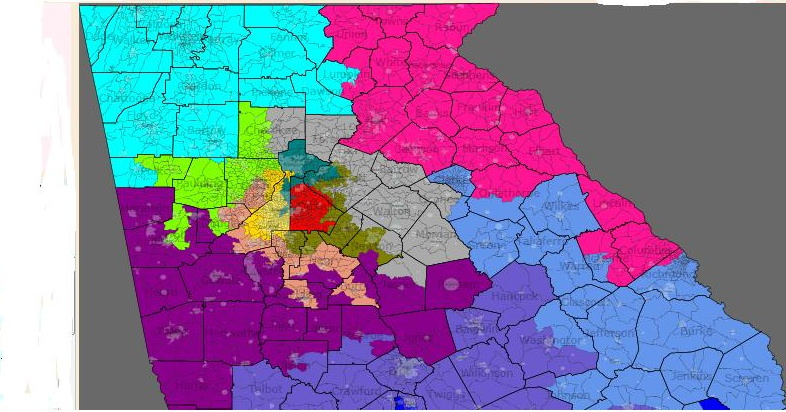
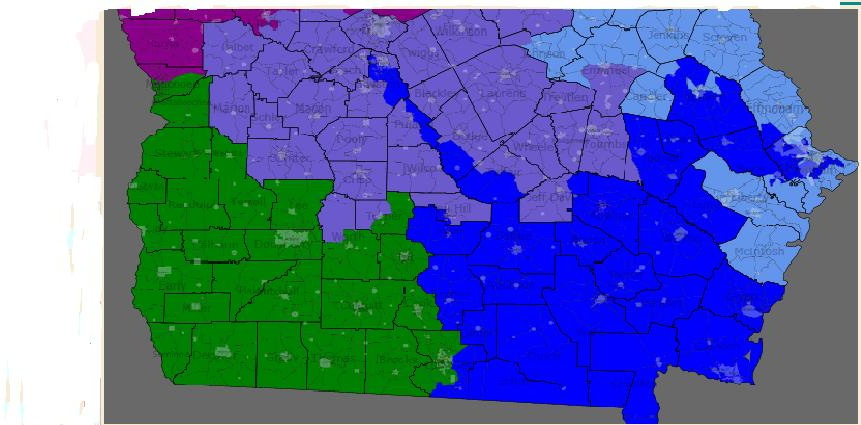
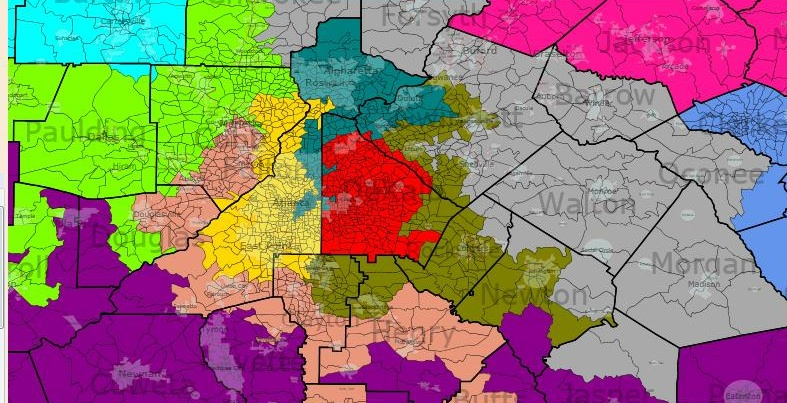
Yesterday afternoon the 12 maps were released by the Joint Committee on Redistricting. The committee has also been tagged as the "Kumbaya Committee" for it's attempt to bring bipartisanshippyness to the most partisan issue possible.
Of the 12 maps, 6 were brought forward by the Democrats on the Committee and 6 from the Republicans. All 6 Democratic maps followed a similar pattern of keeping whole cities intact as well as entire rural counties and were appropriately named "city integrity". The Republican maps all stayed close to the current map, probably realizing that's the best deal they could get at this point.
Several of the changes from both maps incorporated the wishes of different constituencies in the hearings the committee held all over the state. The biggest wish "Keep us separate from Boulder." Other major wishes included putting Grand and Chaffee counties in the 3rd (or at least not in their current 2nd and 5th CDs) and keeping the city and county of Denver whole (which is a shame).
I've only included 1 map from each side as the other 5 on both sides are similar to them and change only a county or city here and there.
• AZ-Sen: Rep. Jeff Flake (R) will apparently announce a haul of more than $1 million in Q1.
• OH-Sen: A spokesman for Treasurer Josh Mandel says he'll file paperwork with the FEC "very shortly," but it's not clear from the writeup whether this means an exploratory committee (what I'm guessing) or if it's the real thing. Also of note: Rep. Pat Tiberi (R), whose name first came up as a possible candidate less than a week ago, quashed any notion that he might run against Sherrod Brown last Friday.
• VA-Sen: If you want to believe CNN's sources, Tim Kaine will announce a Senate bid in the next two weeks.
• WA-Sen, WA-10: Sue Rahr, the conservative King County Sheriff who inherited the job from now-Rep. Dave Reichert, said through a spokesman that she has no intention of running against Sen. Maria Cantwell - a rumor that seems to have gotten shot down before we'd ever heard of it here at SSP. However, a political consultant of Rahr's thinks the sheriff (who supposedly has crossover appeal) could run in Washington's new 10th CD, if a district emerges out of Reichert's 8th centered in the area north of I-90.
Gubernatorial:
• ME-Gov: Will Paul LePage be the next Rick Scott? Like Florida's governor, Republican members of LePage's own legislature are starting to turn on him; eight state senators penned an op-ed declaring : "'Government by disrespect' should have no place in Augusta, and when it happens, we should all reject it."
• MO-Gov: I think it's going to get worse before it gets better for Republican LG Peter Kinder. Trying to push back against revelations that he spend taxpayer money to spend two months a year in St. Louis luxury hotels to attend baseball games, society balls, and teabagger conclaves since 2006, Kinder claimed that his office had been reviewed by two different state auditors, both of them Democrats: Susan Montee and Claire McCaskill (yes, her). The problem? Montee's audit faulted Kinder for "numerous mathematical errors and inconsistencies" regarding employee pay, and McCaskill's found that Kinder used a state-owned care for personal use. I'm sensing a theme here.
• WA-Gov: Could Christine Gregoire's claim to be undecided about seeking a third term really just be a way to ward off lame-duck syndrome? That's Jim Brunner's guess. The Seattle Times reporter points out that campaign finance filings show the Democrat had just $44K on hand at the end of February. At the comparable reporting deadline during the prior election cycle, she had $1.2 million in the bank. Meanwhile, other likely candidates are flush: Republican AG Rob McKenna has raised $800K and has $400K on hand, while Rep. Jay Inslee (D) had $1.2 million in his congressional account at the end of last year. The piece also notes that another possible Dem candidate, state Senate Majority Leader Lisa Brown, has recently discussed a potential run for Lt. Gov. instead. (She'd have to primary Brad Owen, who has been in office since 1997, or push him into retirement.)
House:
• FL-22: Whoa, I was definitely wrong to dismiss "no not that" Patrick Murphy as a Some Dude. One article described him as a 28-year-old accountant, but he's got family money - and, evidently, good connections. Murphy says he raised a majorly impressive $350K in less than a month, and only $30K of that is his own money. Even fundraising machine Ron Klein raised "only" $153K in the comparable quarter in 2005 (before he was first elected).
• NM-01: Terry Brunner, a former state director for the retiring Jeff Bingaman, had previously said he was thinking about running for his old boss's seat, but now says he's considering a run for the 1st CD instead.
• NV-01: Jon Ralston thinks former 3rd CD Rep. Dina Titus will run for Shelley Berkley's seat if the latter runs for Senate, but this is definitely a case of Schrödinger's Seat.
• OR-01: Former state Rep. Greg Macpherson is the first big-name Dem to say he's considering a primary challenge to embattled Rep. David Wu. He wants to wait until the district lines become clear, saying he'll only run if he lives in the district. (He doesn't live there now, but I suppose he could move even if redistricting doesn't help him, so I'm not sure how big an obstacle that is.) He also says he's considering a primary challenge to state AG John Kroger, the man who beat him in the Dem primary for that office in 2008.
• WI-07: Feeling the heat, Rep. Sean Duffy offered a half-assed non-apology, saying his "words were admittedly poorly chosen" when he whinged about getting paid only $174,000 a year as a member of Congress.
Other Races:
• Wisconsin Sup. Ct.: Surprise, surprise: "Citizens for a Strong America," the potemkin right-wing group responsible for several attack ads in the race (including one even PolitiFact rated "pants on fire") turns out to be just a clone/offshoot of Americans for Prosperity, the Koch brothers' arch-evil front group.
• Special Elections: After a few weeks without any state lege races, Johnny Longtorso is back:
While everyone will be focused on the Wisconsin Supreme Court election (which is a phrase I never thought I'd type), there is one special occurring on Tuesday in South Carolina's HD-64, though it's in a safe Democratic seat. Democrat Kevin Johnson, the mayor of Manning, will face off against Republican Walter Sanders.
Also, a quick shout-out to Republican Mike "Pete" Huval, the newest member of the Louisiana House of Representatives from HD-46. He defeated another Republican (no Democrat ran) on Saturday for the seat vacated by now-State Sen. Fred Mills.
Remainders:
• Maps: The National Journal has an interesting set of maps which focus on a theme that DCCyclone has been hitting in comments: Namely, because of population growth among minorities, the share of the white vote that Obama needs in 2012 is lower than it was in 2008, assuming minority support for Obama stays the same. In a very pessimistic scenario where his minority support falls 10%, Obama would only lose three states he otherwise won in 2008 (FL, IN & NC), assuming he keeps the same share of the white vote. (But note that that latter assumption is unnecessary: Even under the reduced minority support scenario, Obama's white support could also drop considerably in many states and he'd still win.)
• Votes: A new study (full paper here) says that Dems who votes "yes" on healthcare reform saw their reelection margins reduced from 6 to 8 points. Something about this study seems incomplete to me, though, but I can't quite put my finger on it. I'll be really curious to read your thoughts in comments.
• VRA: This is interesting: Black lawmakers in Georgia have filed a lawsuit challenging to dissolve the charters of five very white cities in DeKalb and Fulton Counties. The plaintiffs argue that these cities, all formed between 2005 and 2008, were created to dilute minority voting power, and hence violate the VRA. Apparently, this is a novel application of the Voting Rights Act, so we'll see how it unfolds.
• Passings: Very sad news: Former Rep. John Adler, a longtime state Senator who served one term in NJ-03 before losing last year, passed away at the age of 51. Last month, Adler contracted an infection which led to heart disease from which he never recovered. His father also died young of heart disease, something Adler would mention on the campaign trail when describing his family's struggles after his father's death. As a state legislator, one of his signature accomplishments was a smoke-free air bill which banned smoking in many public places. He leaves behind a wife and four children.
In other news, former TN Gov. Ned McWherter also passed away yesterday. McWherter, who was 80, served two terms as governor in the late 80s and early 90s. One of the things McWherter is probably best known for is the creation TennCare, the state's expanded Medicaid program. His son Mike ran an unsuccessful campaign for governor last year.
Redistricting Roundup:
• Arkansas: Rob Moritz of the Arkansas News Bureau has a good rundown of what's going on with Democrats' controversial redistricting plan, dubbed the "Fayetteville Finger." The plan has passed in the House but has stalled in the Senate, where a vote won't come until Thursday at the earliest. At the end of the piece, Moritz details several different alternate proposals pending in the Senate.
• Louisiana: A piece from Sunday's Times-Picayune said that votes were possible on Monday in the House and Senate on congressional maps, but I've not yet seen any subsequent coverage.
• Michigan: Aaron Blake's redistricting series takes him to Michigan, where he has a good explanation of just how difficult it will be for the GOP to shore up its current situation.
• Missouri: Check out this Google Maps version of the state House's proposed new federal district lines.
• New Jersey: Republicans started bitching and moaning about the state's new map even before it was officially chosen, but so far, they haven't said whether they'd challenge the map in court. Not really sure what grounds they'd have even if they wanted to give it a go.
• Nevada: The LVRJ has a piece on the debate in Nevada over whether to create a majority-Hispanic district, or whether to keep Hispanic voters spread out to keep all districts more Dem or more competitive. Most Republicans obviously like the former idea, while Dems (including some Latino lawmakers) are understandably skeptical. Also, it looks like abgin must have trekked all the way from Basque Country to make a presentation at a public hearing in Vegas last weekend: The LVRJ says that "[s]everal interest groups presented proposed maps, including one that likely wouldn't pass legal or political muster because it would create four new vertical congressional districts stretching from North to South."
• Texas: Ah, redistricting cat fud - it has a stench all its own. GOP Rep. Lamar Smith is apparently taking the non-insane view that Hispanic growth and the VRA require that two (well, at least two) of Texas's four new districts be majority-minority, and he's been working with Dem Rep. Henry Cuellar to create a compromise map. This has infuriated fellow Republican Rep. Joe Barton (aka Smokey Joe), who insists that at least three if not all four of the new seats be Republican-favored. And folks, the cat fud is real. Sayeth Politico:
Barton has harshly criticized Smith during Texas GOP delegation meetings, launching a profanity-laced tirade at Smith during one session early last month, and he's privately tried to oust Smith as the lead Republican negotiator on redistricting.
Politico's sources say that Smith is still favored among members of his own party, but that Gov. Rick Perry may be leaning toward Barton. Perry's alleged plan is to skip DoJ pre-clearance and go directly to federal court, perhaps hoping for a friendly conservative panel (backstopped by an unquestionably conservative Supreme Court), so that could turn Barton's dream into a reality... but I still think it's a serious stretch. The piece also reports that proposed maps have been circulated among Republicans, but of course, no one's sharing any copies.
After only two years of a slim 32-30 Democratic majority in the New York State Senate, Republicans in this past election barely took back the chamber that they had previously held continuously for more than forty years. People around the country endlessly ask the question: how is it possible that Republicans have a majority of state senators in a state as "blue" as New York?
There is no simple answer to that question. Sufficed it to say, one of the most important factors is gerrymandering. Republicans did a masterful job of redistricting a very favorable map for themselves ten years ago. The current map is littered with Republican senators holding light blue Obama districts all over Long Island (9-0 Republican) and Upstate (21-4). With the great help of Daves Redistricting App 2.0, I set about in the task of redistricting New York's State Senate districts with three main goals in mind: 1.) connect Democratic towns and cities in Long Island, 2.) preserve majority-minority districts in New York City, and 3.) consolidate small cities Upstate. Much of the basis for my analysis comes from jeffmd's excellent post on the State Senate written in 2009 in which he looked at the numbers for the current districts. Inspecting the presidential toplines, it was determined that the cutoff between Republican and Democratic districts is about 58-60% Obama. My map uses that percentage as the benchmark. It would create 10 Democratic districts at over 58% in Upstate New York and another four at over 62% in Long Island. Combined with New York City, this would be more than enough to give Democrats a two-to-one majority in the State Senate. So without further ado, here is what I came up with:
District
Pop. Center
Pop.
Wh%
Bl%
Asn%
Hisp%
Oth%
O%
M%
D
1
Hamptons
318633
66
11
3
17
2
62
38
R
2
Brookhaven
318569
89
2
2
6
1
49
51
R
3
Lindenhurst
318229
89
2
1
6
1
47
53
D
4
Huntington
318189
60
17
3
18
2
63
36
R
5
Smithtown
318668
91
1
3
4
1
46
54
R
6
Massapequa
318525
90
0
3
5
1
44
56
D
7
Great Neck
318243
67
12
8
11
2
64
35
D
8
Hempstead
318681
51
26
3
18
2
69
31
R
9
Garden City
318620
86
1
5
7
1
43
56
D
10
Jamaica
317030
9
55
9
15
12
Black Majority
92
8
D
11
Bayside
317619
60
5
18
13
3
62
37
D
12
Astoria
315924
42
5
13
34
5
78
21
D
13
East Elmhurst
318053
15
9
16
57
3
Hispanic Majority
81
18
D
14
St. Albans
318613
22
55
4
13
5
Black Majority
82
17
D
15
Forest Hills
316488
59
5
15
17
5
63
36
D
16
Flushing
317432
24
3
48
21
4
Asian Plurality
68
31
D
17
Bushwick
317715
13
13
7
60
6
Hispanic Majority
87
12
D
18
Bedford-Stuyvesant
317273
26
51
2
17
4
Black Majority
90
9
D
19
Canarsie
317538
28
52
3
14
3
Black Majority
83
17
D
20
Brooklyn Heights
318797
25
51
3
18
3
Black Majority
93
6
D
21
Prospect
318898
19
51
5
22
3
Black Majority
92
7
D
22
East Flatbush
317890
21
56
6
12
5
Black Majority
85
14
R
23
Homecrest
316816
81
1
11
6
2
33
67
D
24
Brighton Beach
317711
56
6
21
13
3
55
44
D
25
North Shore
318201
49
13
10
24
4
66
34
R
26
Arden Heights
323582
84
1
6
7
1
37
62
D
27
East Village
311559
45
6
27
19
3
84
15
D
28
Upper East Side
309905
83
3
8
5
2
75
24
D
29
Upper West Side
310495
73
5
8
11
2
85
14
D
30
Spanish Harlem
309111
22
23
3
50
2
Hispanic Majority
91
8
D
31
Bedford Park
308720
12
19
5
61
3
Hispanic Majority
90
9
D
32
Harlem
309836
2
61
1
33
2
Black Majority
97
2
D
33
Washington Heights
309056
22
12
4
60
2
Hispanic Majority
90
9
D
34
Soundview
309592
10
28
3
55
3
Hispanic Majority
90
10
D
35
Belmont
308704
21
21
3
53
2
Hispanic Majority
84
16
D
36
Mount Vernon
309493
14
60
2
20
4
Black Majority
92
8
D
37
Harrison
309361
73
7
5
13
2
61
38
D
38
Yonkers
309287
56
14
5
21
3
64
35
D
39
Ossining
309454
76
7
3
13
1
59
40
D
40
Clarkstown
317946
72
10
5
10
2
53
47
R
41
Carmel
321768
88
3
2
6
1
46
53
D
42
Poughkeepsie
317728
71
12
2
13
2
58
41
D
43
Kingston
320216
85
6
1
6
2
60
38
D
44
Troy
317388
86
6
3
3
2
58
40
D
45
Plattsburgh
317612
94
2
1
2
2
58
40
D
46
Albany
315314
84
9
2
3
1
63
35
R
47
Moreau
317511
96
1
1
1
1
49
49
R
48
Rome
317470
91
4
1
3
1
44
54
D
49
Syracuse
317634
80
12
2
3
3
62
36
R
50
Utica
317412
91
4
1
2
1
54
45
R
51
Herkimer
316544
96
1
0
2
1
45
53
R
52
Blooming Grove
319845
90
3
1
4
1
46
52
D
53
Ithaca
318178
87
4
3
3
2
61
38
R
54
Penn Yan
317011
95
2
0
2
2
47
51
R
55
Perinton
316789
92
3
3
2
1
51
47
D
56
Rochester
318289
60
26
3
9
2
72
27
R
57
Corning
317311
95
1
1
1
2
42
56
D
58
Amherst
317906
80
14
2
2
1
61
38
R
59
Hamburg
318084
94
1
1
2
2
49
49
D
60
Buffalo
317816
67
23
1
6
3
69
29
R
61
Batavia
318545
94
2
0
2
1
41
57
R
62
Greece
318537
93
3
1
2
1
46
52
Note, also, that I broke the state into four regions for simplicity: Upstate, Westchester/Bronx/Manhattan, Brooklyn/Queens/Staten Island, and Long Island. Here is another table that breaks down the numbers by region:
Region
County
Population
Districts
(+/-)
316280
(+/-)
Long Island
Suffolk
1516544
Nassau
1349555
2866099
9
0
318323
0.6
New York City
Queens
2320449
Brooklyn
2588844
Staten Island
496246
5405539
17
1
317972
0.5
Manhattan
1646675
Bronx
1415056
Westchester
961565
4023296
13
1
309484
-2.1
Ustate New York
Rockland
301308
Other
7010169
7311477
23
-2
317890
0.5
As you can see from the table, I redraw the map so that NYC gained two seats at the expense of Upstate New York, while Long Island remained the same at 9 districts. The population of each district in each region is very equal with the greatest deviation of -2.1% below the ideal population in the region of Westchester/Bronx/Manhattan. The rest of the seats compensate for this by being about .5% above the ideal. Before discussing the statewide changes that would occur under this redistricting plan, first let me go through the four regions themselves...
To follow up the series of posts on Colorado, I've posted a few recent presidential elections in the state (courtesy of the New York Times). Each map comes with some brief analysis.
Boosted by a Democratic National Convention held in Denver, Senator Barack Obama wins a thorough victory in the ultimate swing state of 2008. The Democratic candidate does especially well in the Republican-leaning suburbs of Denver - winning several outright and dampening margins in Douglas County and Colorado Springs.
To follow up the series on Virginia, I've posted a few recent presidential elections in the state (courtesy of the New York Times). Each map comes with some brief analysis.
Capitalizing on a decade of Democratic movement, Senator Barack Obama becomes the first Democratic presidential candidate to win Virginia since 1964. The Senator performs best in eastern Virginia, especially the fast-growing northern Virginia metropolis. Western Virginia is not as enamored; parts of it even vote more Republican.
A few maps of Pennsylvania's presidential elections are posted below, for your enjoyment. Each map comes with some brief analysis. Note how in each succeeding election, Democratic margins in the Philadelphia metropolis increase, while their margins in the Pittsburgh corridor decrease.
(Note: Because the Times stopped updating before all absentee/provisional ballots were counted, this map does not fully reflect the actual results. I have corrected the discrepancy.)
As the national tide increasingly turns in Senator Barack Obama's favor, Senator John McCain mounts a quixotic attempt to win Pennsylvania. While Mr. McCain improves in the southeastern rustbelt, Democratic dominance in eastern Pennsylvania ensures a double-digit blue margin.
A few maps of Ohio's presidential elections are posted below, for your enjoyment. Each map comes with some brief analysis.
(Note: Because the Times stopped updating before all absentee/provisional ballots were counted, this map does not fully reflect the actual results. I have corrected the discrepancy.)
Senator Barack Obama wins Ohio by 4.6%, a solid but unimpressive victory. Mr. Obama performs poorly in traditional Democratic areas - the northeast and even Cleveland - but offsets this with unique strength in Columbus and Cincinnati. Senator McCain runs strongly in the Republican base.
Q: Where are the other potential Dem collapse areas this Nov? A: Almost precisely the places Hillary carried in the 08 prez primary
He's definitely on to something. Below is a map of the 2008 presidential primary results in Massachusetts between Hillary Clinton and Barack Obama. Red is Clinton, blue is Obama:
The results between tonight's race and the presidential primary correlate at a rate of 0.56, which is quite high.
• IA-Sen/Gov: The newest Des Moines Register poll by Selzer & Co. has some appalling numbers for Democrats. In the Senate race, Chuck Grassley leads Democratic challenger Roxanne Conlin 57-30. And in the gubernatorial race, incumbent Dem Chet Culver trails Republican ex-Gov. Terry Branstad by almost as wide a margin, 57-33 (with Culver also trailing conservative GOPer Bob vander Plaats 45-37, although Culver beats several other GOP minor-leaguers). A 24-point beatdown is hard to believe given Culver's poor-but-not-abysmal 40/49 approval rating, and this is way out of line with R2K's polling last month, but this being Iowa, I'd be hesitant to bet against Selzer. (Discussion already well underway in desmoinesdem's twodiaries.)
• IL-Sen: Rep. Jan Schakowsky, who was considered a likely candidate in this race for a long time but eventually backed down, endorsed state Treasurer Alexi Giannoulias in the Democratic primary. Giannoulias now has the endorsement of five of Illinois's twelve House Dems. Also today, Patrick Hughes, the conservative alternative to establishment GOP pick Rep. Mark Kirk, is in DC looking for support from conservative movement poohbahs. The DSCC has a well-worth-seeing video out detailing Kirk's transparent shift to the right (especially his pleas for help from Sarah Palin) as he seeks to fight off primary challenges.
• MA-Sen: The voter registration deadline to be able to participate in the primary special election to replace Ted Kennedy is this Wednesday. The primary itself is Dec. 8.
• NY-Sen-B, NY-Gov (pdf): Siena's monthly look at the Empire State shows a little improvement for Kirsten Gillibrand, who now narrowly leads ex-Gov. George Pataki, 45-44. She loses 49-43 to Rudy Giuliani; weirdly, while the rumor mill has until very recently had Pataki likelier to make the Senate race than Giuliani, Pataki now seems much likelier to run for President, while Liz Benjamin is now wondering if Giuliani's recent bout of national security saber-rattling shows he's more likely to run for Senate than Governor.
Meanwhile, Siena has yet another installment in the ongoing David Paterson implosion. Paterson's approval is down to 21/79, 69% would prefer to elect someone else, and he now loses the Democratic primary to Andrew Cuomo by a 59-point margin (75-16) while, in a first, also losing the general to Rick Lazio (42-39) as well as, natch, Giuliani (56-33). Cuomo defeats Giuliani 53-41 and Lazio 67-22. Latest Cuomo rumors involve him trying to assemble a whole slate to run with, and central to that is recruiting outgoing NYC comptroller William Thompson to run for state comptroller. Having the African-American Thompson on a 'ticket' with him would take some of the awkwardness out of Cuomo elbowing aside an African-American governor to avoid a replay of the 2002 gubernatorial primary. Cuomo also wants a female AG (possibly Nassau Co. DA Kathleen Rice) and an upstate LG to balance everything out. Still, that would set up a hot Democratic primary between Thompson and incumbent comptroller Thomas DiNapoli; there's some tension between Cuomo and DiNapoli, though, so that's another instance of two birds, one stone. Finally, in case there were any doubts, Hillary Clinton confirmed that she has no intention of getting in the gubernatorial race.
• SC-Sen: Lindsey Graham, although not up until 2014, could be going the way of Olympia Snowe. There are leaks of private polls showing that more Republicans oppose Graham than support him, and that his support among independents is dwindling too. I guess that's what happens when you vote the party line only 93% of the time.
• TX-Sen: Little-noticed in the announcement on Friday that Kay Bailey Hutchison was going to delay her resignation until after the gubernatorial primary election in March means that, unless she does it immediately afterwards, the special election won't be held until November 2010. Conventional wisdom is that this is good for the GOP, as the seat will be easier to hold as part of a larger election instead of on its own. (Of course, that assumes KBH resigns at all assuming she loses the gubernatorial primary, which somehow I doubt.) The Austin American-Statesman also has a good rundown on what the delay means to all of the potential players in the special election.
• ME-Gov: The Maine governor's race may well wind up as crowded as the one in Minnesota: we're up to 21 candidates, although most of them are minor. One more medium-to-big name is getting in today on the Dem side, though: John Richardson, the former House speaker and current commissioner of the state Dept. of Economic and Community Development. Current Conservation Commissioner Patrick McGowan is also looking likely to get in the Dem field.
• WY-Gov: Former US Attorney Matt Mead has formed an exploratory committee to run for the Republican nomination in next year's gubernatorial race in Wyoming. He joins state House speaker Colin Simpson and ex-state Rep. Ron Micheli in the hunt. Mead, you may recall, was one of the finalists to be picked to replace Craig Thomas in the Senate, but that post went to John Barrasso.
• IL-11: This isn't the way to get your campaign off on the right foot: Adam Kinzinger, who has the insider backing for the GOP nomination in the 11th, stormed out prior to a debate held by Concerned Taxpayers United against his primary competition when one of them, David McAloon, had a staffer with a video camera present. The base in the district is already suspicious of Kinzinger, and ticking them off this way can't help.
• NY-25: One race in a swing district that hasn't been on anyone's radar is NY-25, held by freshman Dem Dan Maffei. He's drawn two potential challengers, wealthy ex-turkey farmer Mark Bitz and former Syracuse Common Councilor Ann Marie Buerkle. Bitz hasn't held office before, but says he's prepared to loan himself a "substantial amount" of money. He'll need it, as Maffei has been one of the freshman class's top fundraisers.
• TN-01: Fans of wingnut-on-wingnt action may be disappointed to hear that it sounds unlikely for ex-Rep. David Davis to take on slightly-more-mainstream Rep. Phil Roe (who knocked out Davis in a 2008 primary) next year. Although he's been staying visible at local tea parties, Davis is focusing on paying down campaign debt from last time.
• UT-02: It doesn't sound like Rep. Jim Matheson is going to face a primary over his health care vote after all; state Sen. Scott McCoy said he didn't intend to go after Matheson, citing the difficulty of a run given the overall composition of the GOP-leaning district.
• Biden Alert: Joe Biden is in the midst of a western swing, doing a Sunday fundraiser for Rep. Dina Titus. Today he's holding events for Ann Kirkpatrick, Harry Mitchell, Martin Heinrich, and Harry Teague, bringing the total to 26 for vulnerable House Dems he's campaigned for. Biden will also be in Connecticut next month for a Chris Dodd fundraiser.
• NRCC: To avoid a repeat of NY-23, the NRCC has basically turned the vetting process over to Grover Norquist and friends. Norquist said that at a recent meeting between the NRCC and conservative movementarians, 40 recruits were discussed and they apparently all met the litmus test (although Norquist grudgingly admitted that some of the northeasterners were "as good as it gets").
• WATN?: Ex-Rep. Bill Jefferson's going to the big house. On Friday, he was sentenced to 13 years in prison after his August conviction for money laundering and wire fraud; this is the longest sentence ever handed out to a former Congressman.
• Maps: As if electoral junkies didn't have enough online tools to geek out over, now there's this: super-helpful step-by-step instructions on how to generate a county-by-county map of the country on, well, whatever topic you want, using only free tools instead of expensive GIS software.
• Site News: We were so busy following the off-year elections that we didn't notice it at the time, but last month, the Swing State Project welcomed its seven millionth visitor. (Number six million came this past March.) Thanks, everyone! (D)
With Missouri most likely dropping a seat and with the redistricting authority evenly split between the Democratic Governor and Republican Legislature, incumbency protection and relatively even numbers of safe and swing districts should be considered priorities. Plus, with the political battles likely to be intense enough to be settled by an independent-ish panel, I figured that drawing geographically-sensical boundaries would also be important.
Therefore, I tried to keep each county in the same district (which I did successfully, barring the expected biggies--Kansas City's Jackson and St. Louis city and county). This was done as a proxy for the "communities of interest" standard that seems to crop up when redistricting time rolls around, but I ain't a lawyer and don't know about no redistrictin'.