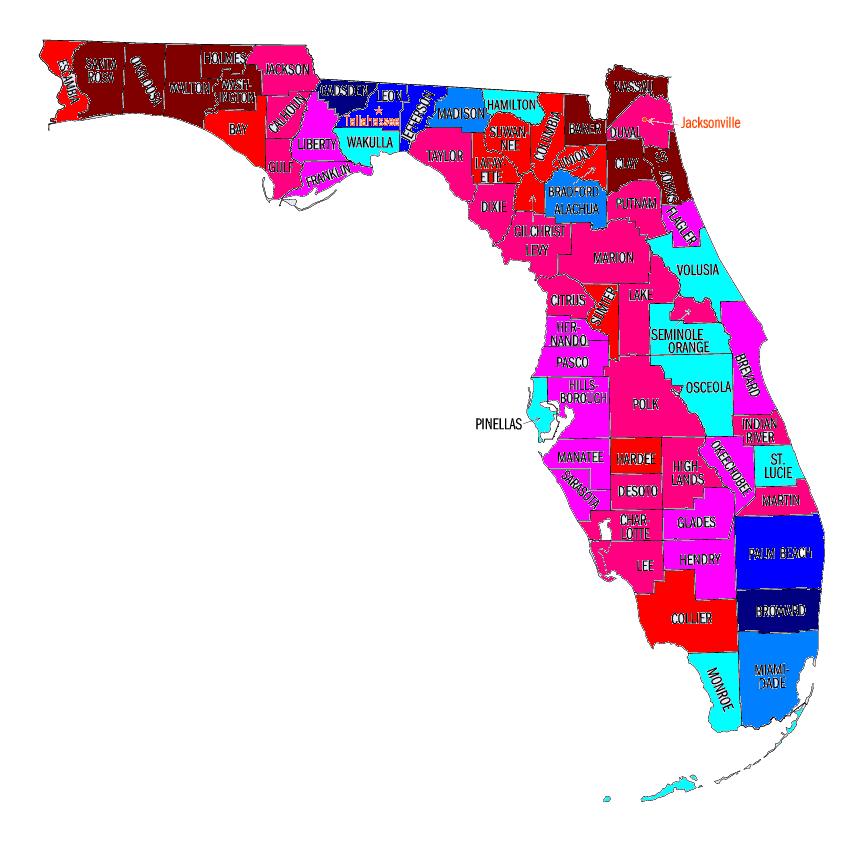
This area is kinda the I-4 corridor. I would say out of the 3 districts I drew which are about 780k people give or take. This is a fast growing area of Florida and this is merely a map that will focus on the communities of interest idea of this area.
This is an attempt to draw new Florida districts based on the initiative they just passed prohibiting gerrymandering. There are three majority-Hispanic, one majority-black, and one plurality-black district all in the state's south end, but beyond that the lines are just geography. I tried to keep counties and metropolitan areas together, and to a lesser extent cities. This map is what I think a neutral Iowa-type commission might come up with, but in practice I think the new map is likely to end up more like Michigan in that the districts will be fairly clean but more subtly drawn to favor Republicans.
Florida was one of the nation's biggest gainers, both in terms of overall numbers (18,801,310, up from 15,982,378 in 2000) and House seats (up two from 25 to 27, making it the only state besides Texas to gain more than one seat). Florida's new target is 696,345, up from 639K in 2000.
Most of the state's gains come in what's called the I-4 corridor, reaching from Tampa Bay through Orlando over to Daytona Beach and down the Space Coast. (Of course, that's not consistent from district to district; the only district in the state that lost outright population is FL-10 in St. Petersburg, and Tampa's FL-11 will also need to gain voters.) FL-05, centered in Pasco and Hernando Counties north of Tampa, is now one of the largest districts in the nation, in fact. Both of the new districts seem likely to be centered somewhere in the I-4 corridor, although there was enough growth in the Miami area that it will need to expand a little, too, shifting in-between districts like the 13th and 16th a step to the north. (Miami area growth was concentrated in FL-25 in Miami's westernmost suburbs; the rest of south Florida, especially the Gold Coast, seemed pretty stable). Despite the GOP-held trifecta, predicting the final map right now is a bit of a fool's errand, though, considering that the effect of Florida's Fair Districts initiatives will probably need to be filtered through the courts and the DOJ.
Florida, as you'd expect, is one of the states showing large-scale Hispanic growth. That's not as clear-cut in the Democrats' favor as it is in other states, in that it has a large Cuban community, although that's largely limited to the Miami area and Cubans are becoming a smaller percentage of the total Hispanic community even there. Hispanic growth in central Florida tends to be Puerto Rican and Central American. The state as a whole moved from 65% non-Hispanic white, 14% non-Hispanic black, and 17% Hispanic in 2000 to 58% white, 15% black, and 22% Hispanic in 2010. While the most heavily Hispanic districts, naturally, remain the three Cuban districts in the Miami area, most of the biggest increases in Hispanic percentage have come in central Florida. In particular, see FL-08 (18% Hispanic in 2000, 26% Hispanic in 2010), FL-11 (20% Hispanic in 2000, 28% Hispanic in 2010), and FL-12 (12% Hispanic in 2000, 21% in 2010). Could we see one of the new districts be a Hispanic-majority VRA district that joins Tampa, Lakeland, and Orlando? The biggest Hispanic percentage increase might surprise you, though: Debbie Wasserman Schultz's FL-20, which went from 21% to 31%, apparently based on a lot of Cuban movement to the suburbs further north).
District
Rep.
Population
Deviation
FL-01
Miller (R)
694,158
(2,187)
FL-02
Southerland (R)
737,519
41,174
FL-03
Brown (D)
659,055
(37,290)
FL-04
Crenshaw (R)
744,418
48,073
FL-05
Nugent (R)
929,533
233,188
FL-06
Stearns (R)
812,727
116,382
FL-07
Mica (R)
812,442
116,097
FL-08
Webster (R)
805,608
109,263
FL-09
Bilirakis (R)
753,549
57,204
FL-10
Young (R)
633,889
(62,456)
FL-11
Castor (D)
673,799
(22,546)
FL-12
Ross (R)
842,199
145,854
FL-13
Buchanan (R)
757,805
61,460
FL-14
Mack (R)
858,956
162,611
FL-15
Posey (R)
813,570
117,225
FL-16
Rooney (R)
797,711
101,366
FL-17
Wilson (D)
655,160
(41,185)
FL-18
Ros-Lehtinen (R)
712,790
16,445
FL-19
Deutch (D)
736,419
40,074
FL-20
Wasserman Schultz (D)
691,727
(4,618)
FL-21
Diaz-Balart (R)
693,501
(2,844)
FL-22
West (R)
694,259
(2,086)
FL-23
Hastings (D)
684,107
(12,238)
FL-24
Adams (R)
799,233
102,888
FL-25
Rivera (R)
807,176
110,831
Total:
18,801,310
Georgia is gaining one seat, from 13 to 14, and with that in mind, its new target is 691,975 (up from 630K in 2000). Pretty much all decade, those in the know have been expecting Georgia's 14th seat to fall in Atlanta's northern tier of suburbs, where the state's fastest growth has been in distant exurban (and virulently red) counties like Cherokee and Forsyth. The new data basically confirms that, with the heaviest gains in suburban/exurban GA-07 (worth noting: Newt Gingrich's old stomping grounds, Gwinnett County, is now the state's 2nd largest county, having shot past Cobb and DeKalb Counties) and GA-09.
Perhaps most surprising is the deep deficit in GA-02, the VRA district in the state's rural South; there had been discussion of it reaching up to take in central Macon in order to make GA-08 safer for its new Republican occupant Austin Scott, and that seems even likelier now, given that may be the only way for it to retain an African-American majority. The two VRA districts in Atlanta will also need to expand outward, but third black-majority seat in the ATL area, the suburban 13th, has plenty of population to spare.
District
Rep.
Population
Deviation
GA-01
Kingston (R)
722,068
30,093
GA-02
Bishop (D)
631,973
(60,002)
GA-03
Westmoreland (R)
817,247
125,272
GA-04
Johnson (D)
665,541
(26,434)
GA-05
Lewis (D)
630,462
(61,513)
GA-06
Price (R)
767,798
75,823
GA-07
Woodall (R)
903,191
211,216
GA-08
Scott (R)
715,599
23,624
GA-09
Graves (R)
823,583
131,608
GA-10
Broun (R)
738,248
46,273
GA-11
Gingrey (R)
794,969
102,994
GA-12
Barrow (D)
692,529
554
GA-13
Scott (D)
784,445
92,470
Total:
9,687,653
The changes in Kentucky are much less dramatic, which stays at six seats, has seen little change in its racial composition, and which probably won't even see much movement of its current boundaries. Its current target is 723,228, up from 673K in 2000. As in many states, the truly rural districts (in this case, the west Kentucky KY-01 and Appalachian KY-05) were stagnant, and will need to gain population from districts with exurban populations (KY-02, which includes Louisville's southernmost 'xurbs, and KY-06, centered on Lexington).
This diary presents a 27-seat map for Florida using the new ACS data and the guidelines of the newly passed Fair Districts amendment. It goes very heavy on respecting local boundaries, sometimes to the detriment of minority districts; a couple of alternate area maps are presented at the end to rectify that. My hope is that this map represents the most extreme fidelity to local boundaries that's possible, in order to serve as a baseline for other proposed maps. Please let me know if you think there's someplace that fidelity can be enhanced.
Florida's gaining two seats. It's pretty easy to say that one is FL-19, based in Indian River, St. Lucie, and Martin Counties on the south central Atlantic coast. The second one is harder to discern; I think it's best to say that the old FL-03 is gone and has been replaced by the new districts in Orlando and Jacksonville.
As drawn, the map renumbers all of the districts from northwest to southeast. Here's an overview map.
Fair Districts
For reference, here's the ballot summary of the Fair Districts law:
Congressional districts or districting plans may not be drawn to favor or disfavor an incumbent or political party. Districts shall not be drawn to deny racial or language minorities the equal opportunity to participate in the political process and elect representatives of their choice. Districts must be contiguous. Unless otherwise required, districts must be compact, as equal in population as feasible, and where feasible must make use of existing city, county and geographical boundaries.
Not taking political ramifications into account was actually easy. Florida's a pretty difficult state to get elections information for. So much so that even after drawing the map, I'm having a hard time assessing it. My comments are based on existing PVIs as listed on Wikipedia and the map from Inoljit's recent diary on the 2010 governor's race. Feedback from those with knowledge about Florida's politics is greatly appreciated.
Following existing local boundaries has a pretty dramatic impact on the overall map. Currently, the 10th district in Pinellas County is the only district entirely within one county. Under this new map, there are nine districts that are wholly within a single county: two each in Miami-Dade and Broward and one each in Palm Beach, Pinellas, Hillsborough, Orange, and Duval. Overall, I'm happy with my map's compactness and respectfulness of local lines, although I'd be happy to see other attempts. Note that the only boundaries I had references for are the county lines and the incorporated cities lines available in the old version of the App. I don't even know if Florida has something equivalent to midwestern townships, so if it does, I wasn't able to take them into account.
Protecting the opportunities of racial and language minorities was a more difficult aspect of this map. My lay understanding of the current state of VRA law runs something like this: minorities that can be given compact districts where they're 50% or more of the population must be given them, but it's unconstitutional to "gerrymander" together unwieldy districts for them -- although considering that NC-01 apparently passes muster, I'm not quite sure how to tell what's too unwieldy. There's also, I suppose, the question of to what extent the Fair Districts language goes beyond what the VRA requires.
For my main map, I decided that both Brown's and Hasting's districts were too unwieldy to be maintained. Dismantling Hasting's district is probably the worse call. While ugly, it could be drawn at more than 50% African American while staying entirely within two counties; anything similar to Brown's current district wouldn't pass the 50% mark and would require a whole lot of county-splitting. At the same time, however, breaking up Hasting's district allows for four of the six districts wholly or partially in Broward and Palm Beach to be majority-minority (although three of those are white-plurality.) Constructing something similar to Hasting's current district causes four of those six districts to become white majority.
The Decision Points
Putting that another way, I really consider myself to have made only three significant decisions on this map - everything else seemed more or less dictated by the geography and demographics. Now, that might not be an accurate self-perception, but that's how I feel about it.
Two I've already covered:
1) Will the plurality African American district in north Florida be maintained?
2) Will the majority African American district in Palm Beach and Broward Counties be maintained?
And then there's the previously unforeshadowed:
3) Polk and Osceola Counties together are 150k too many people for a district. Which 150k people are they and to which district are they being attached?
For my main map, the answers are "no", "no", and "Kissimmee and environs are going north to the western Orlando suburan/exurban district". I'll talk more about this third choice in the district-by-district descriptions.
At the end of the diary, I've included alternate versions that look at the other answers to those questions. The map that switches the first answer to a yes is based on powera's diary from a few weeks ago, with a Jacksonville-Tallahassee majority-minority district. The map that switched the second answer to a yes is based on the existing FL-23, altered to better suit the Fair Districts requirements. And then the final map changes the answer to the third question to "Lakeland and environs are going north and west connecting to a district in Pasco County".
District-by-district description is after the jump.
This is a part of a series of posts analyzing the 2010 midterm elections. This post will discuss the 2010 Florida gubernatorial election, which Republican candidate Rick Scott won in an extremely close contest.
Florida's Gubernatorial Election
On November 2010, Democrat Alex Sink faced an extremely flawed Republican opponent: multimillionaire Rick Scott, a businessman accused of heading the biggest fraud in Medicare history.
Ms. Sink still lost, running in a Republican leaning state in a very Republican environment. Here is what happened:
This is my first diary post using Dave's App, so any suggestions are welcome :)
I tried to create a slight Democratic Gerrymander of Florida. I didn't follow VRA very much, so I will be working to make a VRA map with 2 AA majority districts and 3 hispanic majority districts. I don't believe the DOJ will require a 3rd in North Florida (Corrine Browns awful district.)
But being able to basically ignore the VRA in Florida opens amazing opportunities, especially in South FL. And luckily, some of the districts around the Tampa Bay area and a few others may end up being the actual districts with the new Fair Districts initiative being passed.
1) Will the fair districts law hold up in court?
2) Will Corrine Brown get a district that goes Jacksonville to Orlando, or will it go to Tallahassee?
3) How many "compact" Orlando seats are drawn, and how many go into rural areas?
I'm assuming (or at least hoping) that we will see some less gerrymandered lines. It might be interesting to see what the best case GOP map is, though. I don't think 21-6 could work, 20-7 may have to be uglier than what we have now.
I'm not sure of the politics of some of these seats, but my take is that the Democrats gain one seat in the Orlando area, have better chances at two seats in the Tampa area (Bill Young and Vern Buchanan both lose some blatant gerrymanders), and probably pick up Allen West's seat. David Rivera is almost certainly gone in 2012 as well, though that might be a primary.
VRA - 3 plurality black seats, CD3 at 47B, CD17 at 47B, CD23 at 39B. I'm not sure you can do much better with nice lines; there just aren't enough blacks in Broward county to make Hastings' seat more than plurality black. Kathy Castor's CD11 is at 46W, as is CD8 in Orlando. The 3 Hispanic R Miami seats are all at least 65H.
Now that it's 2011, the redistricting games will soon begin in earnest, with more detailed Census data expected in February or March and some states holding spring legislative sessions to deal with drawing new maps. Long ago I planned to do state-by-state rundowns of the redistricting process as soon as 2010 election results and Census reapportionment were clear. Now that time has arrived, and it's time to look at Florida, Georgia, and Hawaii.
MIAMI GARDENS, FLA - Kendrick Meek, Democratic candidate for U.S. Senate, continues to consolidate support from Florida Democrats as he receives the endorsements of Rep. Mark S. Pafford (D-West Palm Beach), Rep. Darren Soto (D-Orlando), and Rep. Scott Randolph (D-Orlando). Statements by Rep. Pafford, Rep. Soto, Rep. Randolph and Kendrick Meek follow:
Rep. Pafford (D-West Palm Beach) said, "Kendrick Meek's career has always been defined by his commitment to the people of Florida. Like me, he has stood in opposition to big oil and offshore oil drilling to protect Florida's coastlines. Kendrick also understands the importance of protecting another natural resource: our children. As a father I am grateful that Kendrick fought to restrict class sizes so that our children can excel. I am honored to give Kendrick my support and will continue to fight with him for Florida."
"Kendrick Meek has a long and reliable record of supporting issues Hispanics care about, including a strong economy, advancing education through smaller class sizes, equality, and fair wages. He was a strong supporter of Justice Sotomayor's nomination and is against the Arizona style immigration law, issues important to our community. Kendrick Meek has asked for our support and I am honored to stand by him in Central Florida," said Rep. Soto (D-Orlando).
"Kendrick Meek has been protecting the people of Florida since his days as a Florida State Trooper. He's not afraid to stand up and speak truth to power. In his opposition to HB 1143, Kendrick stood for all women as a champion of choice. Kendrick is committed to securing justice for every Floridian, not just the ones with big pocketbooks. I am proud to stand by Kendrick and endorse his candidacy for the U.S. Senate," reported Rep. Randolph (D-Orlando)
"I am honored to have the support of these three outstanding public servants. They have each fought tirelessly for the state of Florida and aren't afraid to stand their ground on tough issues. These three men work relentlessly to protect the people of Florida because they understand what's at stake. They are leaders who have strong roots in Florida and in their communities. I value their vision and their insight as principled men of character. Florida is fortunate to have them and I am honored to receive their support," said Kendrick Meek, Democratic nominee for U.S. Senate.
Our campaign has also picked up the support of Al Gore, as he writes.
Florida has had its share of close elections, but this Senate race really ought to be a landslide. And it would be if people just look hard at the facts.
Kendrick Meek is the only one in this race who has consistently opposed offshore drilling. He is the only one who will ensure that we all have quality health care, and the only one who will focus on helping working Americans, rather than wealthy corporations.
Here is the bottom line: We have to help make sure Florida voters have all the facts about Kendrick and his opponents.
We've got just 42 days until Election Day, and Kendrick needs your help so he can keep his ads on the air and tell it like it is. His opponents are getting all the help they need - from corporations and special interests. Kendrick relies on you-his grassroots supporters. He needs you to make a donation today so he can raise $75,000 before the critical September 30 end-of-quarter deadline.
Click here to make an immediate donation to Kendrick's campaign. He needs his grassroots supporters to help him raise $75,000 by the September 30 deadline.
As you know, I'm working hard to raise awareness about the serious threats to our environment. One reason it's so hard is because the polluters don't want any protections for the environment that might reduce their profits, so they have managed thus far to kill climate change legislation that would have protected our children and grandchildren.
Unlike his opponents, Kendrick Meek never has been and never will be in the pocket of these special interests. He was against offshore drilling long before the terrible oil spill in the Gulf, and he's always worked to protect our beaches and wildlife, research and develop energy sources like solar power, and promote a better environment.
With Kendrick in the U.S. Senate, we can rest assured that there's somebody in Washington looking out for us. But that will happen only when he can raise the funds to stay on the air until Election Day-just 42 days away. You are an integral part of Kendrick's campaign because he relies on you for support, not oil companies and special interests.
Please make a donation to Kendrick's campaign today and help him reach his goal of raising $75,000 before the September 30 deadline. If he reaches this goal, I know he'll be able to win in November.
Once people get the facts, the choice will be clear and Kendrick Meek will be the new United States Senator from Florida. With your help today, we can make sure the facts get out.
Sincerely,
Al Gore
We are also having a Rally for Kendrick Meek with former vice president Al Gore.
THURSDAY, SEPT. 30TH
DOORS OPEN: 4:45PM
TAMPA LETTER CARRIERS HALL
3003 W CYPRESS ST
TAMPA, FL 33609
RESERVED TICKETS AVAILABLE ONLINE AT http://www.kendrickmeek.com/al... OR CALL 877-354-6335 FOR DISTRIBUTION LOCATIONS