Google Ads


Site Stats

South Carolina 2-VRA Seats "This is Immoral"

by: notifier

Mon Jan 17, 2011 at 6:39 PM EST


This is a quick attempt at South Carolina with 7 seats and 2 Minority Majority districts.

SSPers speculated that there should be a second VRA seat in South Carolina, as there is a substantial black population. Personally I do not think South Carolina should have gotten another seat, the data on Daves App shows South Carolina at 4.5 Million or so, and 2010 Census showed it at 4.6 M or 663,710 per district. I however feel that as long as the US House stays with 435 seats and the size of each constituency rises with each census apportionment, the utility of VRA seats are going to collapse onto themselves.

We see instances like Mel Watt (NC), Corrine Brown (FL), and Sanford Bishop (GA) that getting 50% of their districts Black is a hard order when trying to make a district that has at best moderate gerrymandering.

South Carolina has a large African American population 30% in the 2000 Census; however the population is way too spread out to make a coherent congressional district within a state. As seen here
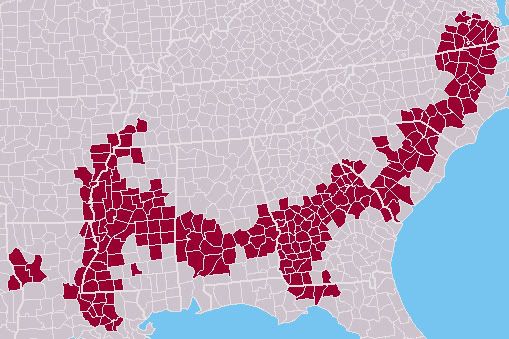
Photobucket

And my map seen here

Photobucket

It just is too agressive to get a 50% district and a 49% district. Also notice that the 4th district (yellow) is just barely contiguous. This gerrymander will only see Clyburn, Scott and Dowdy  keep their seats I believe. It does really put Joe Wilson into a very strange district.

notifier :: South Carolina 2-VRA Seats "This is Immoral"
Tags: , , , , , , , , (All Tags)
Print Friendly View Send As Email

huh
interesting map, but i don't think it relates completely to ur post

18, Dem, CA-14 (home) CA-09 (college, next year). social libertarian, economic liberal, fiscal conservative.   Everybody should put age and CD here. :)

Sorry
Hit save instead of preview and forgot the page. Updated with the SC Map

[ Parent ]
Legal Obligation
Is South Carolina under any legal obligation to create a second minority-majority district?  I'm not sure who is in charge of their State House/Senate but if its the GOP why would they have any incentive to make a second one?

if the doj
refuses to clear their map otherwise. plus, joe wilson isn't exactly safe (look at his results from last year)

18, Dem, CA-14 (home) CA-09 (college, next year). social libertarian, economic liberal, fiscal conservative.   Everybody should put age and CD here. :)

[ Parent ]
The new district
could obviously be used to protect SC-2 while remaining a Likely R district.

[ Parent ]
DOJ couldn't require this map
You're only required to draw a Majority-minority if it can be done while remaining fairly geographically cohesive. This is a mess and would get struck down by the Court.

[ Parent ]
Not this map
but maybe the one posted by roguemapper below.

Ad hoc, ad loc and quid pro quo!
So little time, so much to know!


[ Parent ]
Actually, Charlie Cook is in charge of the State House/Senate
at least that's what I'm led to believe from johndemetre, who not only kindly informed us that Mr. Cook is going to be drawing the map, but even got to see the map himself! (It's already been drawn, you know.)

21, dude, RI-01 (registered) IL-01 (college)
please help Japan. click "donate funds" in upper right and then "Japan Earthquake and Pacific Tsunami." http://www.redcross.org/


[ Parent ]
SC-7
The new district in SC is projected to be anchored by Horry County on the coast and include the Pee Dee region! It will be a Lean R district! I have alread seen a map at Cook Political on what SC will look like! SC 2 and SC 5 will be made safer by removing a few black majority rural counties! Am anticipating a 6-1 map, I think it has already been discussed that SC would not be required to add a second AA district!

i think
all you saw on cook was a prediction by charlie cook. but i like the enthusiasm for redistricting :)

18, Dem, CA-14 (home) CA-09 (college, next year). social libertarian, economic liberal, fiscal conservative.   Everybody should put age and CD here. :)

[ Parent ]
VRA
The VRA may very well mandate a second minority district in SC. If a compact 50% minority district can be drawn, then it must be drawn if required in accordance with the Gingles test (as recently affirmed by the Supreme Court in Bartlett v Strickland).

I've been talking a lot here lately about cases where the VRA does not require minority districts to be drawn, but if the demographic figures are correct at Dave's app then South Carolina will almost surely have to draw a second minority district.

Here's a map with two compact majority-minority districts:


[ Parent ]
VRA
Clyburn was asked in the SC State paper recently and he said he was quite sure the new district would be a Republican leaning Horry based seat! I do believe he would know!

[ Parent ]
That's only if
the DOJ clears the GOP's map of choice.

Ad hoc, ad loc and quid pro quo!
So little time, so much to know!


[ Parent ]
None of these southern maps
will go to DOJ.  Bank on it. Straight to DDC.

[ Parent ]
What's DDC?
And why won't the DOJ look at them?

Ad hoc, ad loc and quid pro quo!
So little time, so much to know!


[ Parent ]
He probably meant the D.C. Circuit
The VRA allows a state to sue for declaratory judgement there instead of submitting their maps for preclearance.  

[ Parent ]
Wouldn't it go
to the 4th circuit?

Ad hoc, ad loc and quid pro quo!
So little time, so much to know!


[ Parent ]
No
The VRA specifies the D.C. Circuit. Many such statutes do.  

[ Parent ]
Ok.
Geez, so much complexity.

Ad hoc, ad loc and quid pro quo!
So little time, so much to know!


[ Parent ]
Judge Merrick Garland...
Doesn't want to deal with any of this, I'm sure. I suspect if he had to rule on a controversial map for VRA preclearance, it would doom his chances of landing a spot on the Supreme Court.

20, center-left independent, Auckland Central resident, MD-05 voter, OR-01 native

[ Parent ]
Clyburn
Is not a judge, and this is not debatable (that's the whole point of a bright-line rule, which is what the Supreme Court claimed to have set up in Bartlett).

Either you can draw two compact 50% minority seats or you cannot. If anyone presents a SC map in court that includes two compact 50% minority seats, then if the legislature's map does not feature two minority seats the court will strike it down.

There will be no problem satisfying the Gingles test in South Carolina.


[ Parent ]
For a variety of reasons
not worth rehashing, I do not think much of the political ruminations of Jim Clyburn.

I also think that he has a fair number of Republicans friends in the SC legislature. I base that on the special provisions that he put into the stimulus package to bypass Mark Sanford.


[ Parent ]
VRA
Clyburn was asked in the SC State paper recently and he said he was quite sure the new district would be a Republican leaning Horry based seat! I do believe he would know!

[ Parent ]
If he said that
I would speculate that it's because he doesn't want to give the SC Republicans a reason to mess with his district.  

[ Parent ]
Thanks for
that delightful counterpoint map.

Ad hoc, ad loc and quid pro quo!
So little time, so much to know!


[ Parent ]
That's my understand of the state of the law
as well. However, for some reason it seems that such maps are not always drawn.  

[ Parent ]
In the case of SC
You certainly cannot draw two compact 50% minority districts when dividing the state 6 ways, but it's quite likely you can do so when dividing the state 7 ways.

And that makes all the difference.

It's also worth noting that there have been two substantial legal changes since the last round of redistricting:

1) The Supreme Court record now includes LULAC, NAMUDNO, and (most importantly in this regard) Bartlett.

2) The VRA was revised in 2006 to specify that what is relevant is discriminatory effect, regardless of whether discriminatory intent is involved.

Both developments obviously arrived too late to influence the last round of redistricting, but they should be quite significant in the upcoming round.

In particular, the idea that a 65% minority district is preferable to a pair of 52% minority districts is virtually obsolete; and, the current state of the law would suggest that the latter would be required if it were a viable alternative.


[ Parent ]
I agree--that's my understanding
of the current state of the law. What's interesting about Bartlett is that the bright line test is really quite crude under these circumstances. Imagine if Texas Republicans try to use it as a safe harbor.  

[ Parent ]
My opinion
Texas will no doubt be tricky. The thing about Texas is that it's quite possible to draw bare majority-minority districts that would be expected to elect Republicans. I've done some partial Texas maps myself (nothing I'm ready to post yet), and I'm fairly certain that you could actually add four slightly majority-minority districts that would all be GOP districts (based on past performance).

Were that the case, it's difficult to predict what the legal outcome would be. My expectation is that there would be a legal challenge on the basis that such districts failed to create a genuine opportunity for the minority population to elect the candidate of their choice. In order for such a challenge to succeed, the Supreme Court would have to issue a more nuanced reading of the VRA than that in Bartlett v Strickland.

In short, the Court would have to more precisely reconcile Bartlett with Thornburg v Gingles. I think that the outcome could be highly contingent on the precise composition of any challenged districts, and it's impossible to make a prediction until we have some concrete idea of what the Texas legislature wants to do.


[ Parent ]
What it proves
is that the "bright line" didn't settle anything, unless it was intended to gut the VRA. As Souter explained in dissent:


The plurality argues that qualifying crossover districts as minority-opportunity districts would be less administrable than demanding 50%, forcing courts to engage with the various factual and predictive questions that would come up in determining what percentage of majority voters would provide the voting minority with a chance at electoral success. Ante, at 12-13. But claims based on a State's failure to draw majority-minority districts raise the same issues of judicial judgment; even when the 50% threshold is satisfied, a court will still have to engage in factually messy enquiries about the "potential" such a district may afford, the degree of minority cohesion and majority-bloc voting, and the existence of vote-dilution under a totality of the circumstances. See supra, at 5-6, 8. The plurality's rule, therefore, conserves an uncertain amount of judicial resources, and only at the expense of ignoring a class of §2 claims that this Court has no authority to strike from the statute's coverage.

. . .

[T]he plurality tries to support its insistence on a 50% threshold by invoking the policy of constitutional avoidance, which calls for construing a statute so as to avoid a possibly unconstitutional result. The plurality suggests that allowing a lower threshold would "require crossover districts throughout the Nation," ante,at 17, thereby implicating the principle of Shaw v. Reno that districting with an excessive reliance on race is unconstitutional ("excessive" now being equated by the plurality with the frequency of creating opportunity districts). But the plurality has it precisely backwards. A State will inevitably draw some crossover districts as the natural byproduct of districting based on traditional factors. If these crossover districts count as minority-opportunity districts, the State will be much closer to meeting its §2 obligation without any reference to race, and fewer minority-opportunity districts will, therefore, need to be created purposefully. But if, as a matter of law, only majority-minority districts provide a minority seeking equality with the opportunity to elect its preferred candidates, the State will have much further to go to create a sufficient number of minority-opportunity districts, will be required to bridge this gap by creating exclusively majority-minority districts, and will inevitably produce a districting plan that reflects a greater focus on race. The plurality, however, seems to believe that any reference to race in districting poses a constitutional concern, even a State's decision to reduce racial blocs in favor of crossover districts. A judicial position with these consequences is not constitutional avoidance.

The whole thing is worth reading.


[ Parent ]
Well
The only thing I would point out is that Latino districts and AA districts operate very differently for the simple fact that the black vote is about 90% Democratic whereas the Latino vote is generally 60-70% Demcratic.

Clearly then, whereas a bare-majority AA district in South Carolina would be all but assured of electing a black Democrat, a bare-majority Latino district in Texas would be a swing district at best.

So then, the Gingles test becomes more problematic when the minority population itself is not voting as a bloc, before you even get to the issue of whether the white majority is voting as a bloc.

What that would've meant during the O'Connor era is that you'd end up mired in some convoluted 'totality of circumstances' analysis. I'm not sure what it means post-O'Connor. I doubt anyone could venture a reliable guess -  besides Anthony Kennedy (and even that's debatable).


[ Parent ]
I think in both TX23 & especially TX27
we see GOP draw seats with 65% hispanic population but there will be two very key elements in how these seats are drawn.

1. There will be an emphasis where was the hispanics are located is located. Within each of these two districts are distinct hispanic population bases and there a difference in turnout based which community is included.

2. On the flip side in Bexar and Nueces county there are white communities that are very republican and are high in voter turnout.  There will be very delicate carving of lines these two seats.

The local talk is that Farenthold will have to rise or fall in TX27.  


[ Parent ]
I'm having trouble replicating your map
without coming very close to 50% white. Your yellow district is 49% white, and just 7K people short of 50% white. Your green district has a white majority of about 1000 as best I can approximate it. So I think there's a decent chance neither of these is majority-minority due to population changes.

Could you post your racial percentages for these as well as some close-ups of your lines in Charleston and Columbia?

Moderate Libertarian Republican, MA-8 (college) / MD-7 (hometown)


[ Parent ]
You don't have to
use so many damn exclamation points.

Ad hoc, ad loc and quid pro quo!
So little time, so much to know!


[ Parent ]
The 1st map above
is what has been called for generations "The Black Belt". The term has a double meaning as it a swath of land with  dark soil that is very productive.  In NC & VA and SC its land that was rich in Tobacco and Cotton farming.  In Georgia the Black belt was cotton and later peanuts.  From Georgia to Miss it was King cotton.

The other meaning is that this area of rich farmland is where you will find the highest % of rural black population in the USA.  In old days they were as planation slaves and then after the war sharecropping and today you see the highest concentration of black owned farms in this belt.  

The Black belt rules into the Delta and now either side of the Mississippi from New Orleans to Memphis you see rural counties with a high % of black population.  The old saw was that the Mississippi Delta started in the lobby of the Peabody hotel in Memphis.  These rich farming areas of the Delta and Black belt was where you needed many people to work the farms.  Tobacco farming is very labor intensive.  Until the mechnical cotton picker-WWII era you had to pick cotton by hand.  You needed a large cheap workforce to that type of farming.  

The majority of Black belt counties are still majority AA to this day.  Not all.

What's the implication of the black belt?  Do a topographic map of SC. The Belt belt wraps arounds that mountain range that starts up in Maine and runs down the spine of the Eastern part of the USA. In the hills and plateaus of these hills plantation farming did not occur as the land was not suitable so even today the AA population is much lower in the peidmont area of SC.

I might add that in portions of NC-VA-TN in hills where the land was not suitable for cotton farming slavery nothing really took root.  This is where you find many historically republican counties.  

What's fascinating about parts of the South is that you can see what type of farming was done in 1840 and then see the political effects up to the current time.  


One minor point...
Personally I do not think South Carolina should have gotten another seat...

Assuming actual population counts are not litigated, there isn't any room for debate when it comes to which states earn additional seats and which states don't, nor are pre-census estimates involved.

Determining the apportionment of seats - given the population counts of states - is a pure mathematical exercise in optimization.


Eh
the persistence of apportionment paradoxes makes it clear that there is, indeed, room for debate about that.

However, if we start from the premise that we're stuck with 435 and Huntington-Hill, then you're right that there isn't anything to really debate beyond the count (especially considering the way the Supreme court butchered the meaning of "count").


[ Parent ]
I was taking as given...
the use of "apportionment population" and Huntington-Hill.  

All I meant to say was that given the lack of a serious push ( this reapportionment cycle) to switch away from H-H (as applied to 435 seats) and given the population counts as the Census showed them to be, South Carolina's 7th seat is not a matter of debate.


[ Parent ]
There's so much wrong
with the way we structure Congress that it's hard to know where to start. The easiest thing to do would be to increase the size of the House. The harder (but more important) change would be to abolish (or proportionalize) the Senate.  

[ Parent ]
I Was Reading Szpiro's Numbers Rule This Morning
The 3 chapters dealing with reapportionment over the course of US history, and the triumph of Huntington-Hill, were great.

[ Parent ]
Virginia and South Carolina
Virginia and South Carolina seem to be in the same situation; as shown, it's not terribly hard to draw two black majority districts in South Carolina, and on a parallel track, it's pretty easy to draw two black majority districts in Virginia as well (one centered on Richmond, the other based out of Norkfolk). Both have the demographics do back up a second minority seat in each state as well. Bottom line is that what happens in one will likely affect the other.

Am I off base?
I believe the idea of the topic creator was to prove that two compact VRA districts cannot be drawn by showing that it is possible to draw two non-compact VRA districts?

Shouldn't this method be possible anywhere? I mean it should be possible to draw some non-compact VRA districts in Chicago.  


[ Parent ]
Well
I'm not sure what the motivation was of the person who posted the diary, but if that's what he was getting at then he is incorrect (at least, according to the demographic figures at Dave's app).

When I first posted to this diary, the South Carolina map was not included (the diarist edited it in afterward). If it were, then I would've said that such a map would be instantly rejected as a racial gerrymander per Shaw v Reno.

However, as my map posted in the comments above demonstrates, you do not need to draw these absurd districts in order to get two majority-minority seats. I'm not sure why the diarist thought that would be necessary.


[ Parent ]
I'm referring to your map
When I say that you can draw two compact districts, yours is the map I was referring to.

[ Parent ]
My intent
My intent was to post a diary on the districts but I hit submit by accident. I suppose now we can talk about VRA in SC lol

[ Parent ]
Full Map
FWIW, here is a full SC map with 2 compact minority-majority districts. The yellow & green districts on this map are both 52% minority. I've actually endeavored to make them even more compact than in my quick initial map.

By my calculation the yellow Columbia-based district would've been 59% Obama in '08 and the Green Charleston-based district would've been 57% Obama in '08.


SC-06
By comparison, Clyburn's SC-06 district was 58% Gore in '00, 61% Kerry in '04, and 64% Obama in '08.

It is a 59% minority district.


[ Parent ]
Absolutely beautiful map
Sterling work here. I can easily see a court-drawn map looking very much like this.

20, center-left independent, Auckland Central resident, MD-05 voter, OR-01 native

[ Parent ]
off topic
but how do u find the archives for this site?

i wanna start going through and reading old things. is there a chronological archives?

18, Dem, CA-14 (home) CA-09 (college, next year). social libertarian, economic liberal, fiscal conservative.   Everybody should put age and CD here. :)


[ Parent ]
Very good job again.
I also hope the incoming racial data bolsters the legitimacy of your maps even more.

Ad hoc, ad loc and quid pro quo!
So little time, so much to know!


[ Parent ]
Numbers
I don't think your map is what you claim, the districts are either underpopulated by 40k or they are 49% White.

[ Parent ]
Screenshots
Here are screenshots:


[ Parent ]
That is a very impressive map
and I love the colour--I like the compactness.  I am a fair piece as we say down herefrom South Carolina but I learned interesting tidbits after the 2010 election results came out.

I wondered why Joe Wilson lagged behind the other GOP candidates in this year.  His 53% was very low compared to the other GOP congressman in SC and all the others were freshman.

Yes Richland county went heavily democratic this year but the major reason for Wilson's weakness is that the university area and apparently state workers went strong D this year.  For that matter they voted strong for Obama in 2008.  This area in Richland county is one of the few pockets of democratic strength in SC that is not AA.

So what?  I suspect your yellow district will have a stronger Obama vote then your green district.  The AA% will be about the same but I think the vote difference will be several % different.

My guess for SC redistricting is Wilson ditched Richland county.  I don't see a second AA seat being drawn by the GOP-not willingly at least and the new guy Mulvaney slide down to Horry county.  

The New seat in SC-if the GOP has its way-I predict will be part of Spartenburg part of York  Laurens Union-Newberry-Fairfield then slide into Richland. Clyburn's seat will be pretty similar.

I don't see a Horry based seat as Wilson need to ditch Richland county. I am not sure a Horry county to Darlington to Richland county would be GOP enough.  

just my guess--what my crystal ball sees.  The key is where Richland-outside of Clyburn's seat ends up.  


[ Parent ]
VRA
I haven't been all that intent on mapping out potential VRA seats because the demographic data at Dave's app is evidently way out of date. As I've said before, my maps are only as good as the data that they're based upon.

Obviously, if you can't make such a map with the true data, then this is all a moot discussion.

Then again, it might prove true that you can make two minority-majority seats in SC even more readily with the actual data. Dave's app is 200,000 short. If a big chunk of the shortfall are Latinos (and the Latino population in the Carolinas has spiked over the past decade for sure) then it's virtually assured you can make two compact seats with minority percentages even higher than what I've done here.

And, of course, you're right: The SC GOP will not create two VRA seats without compulsion. Then again, that's the whole point of the VRA, isn't it?

I guess we'll see.

In the meantime, this has inspired me to look at potential VRA seats in other southern states. I'm close to having a Georgia map ready to post.


[ Parent ]
I suspect states like SC will get to it quickly
as DOJ will need time to  review.  I suspect they will draw legislative lines at the same time.  Just a guess but we might see congressional lines drawn quicker this time around.  

[ Parent ]
SC-7
You are right that Wilson's percentage was down from the four freshman gop'ers, if you look at the county numbers Wilson lost Richland and 2 of the small AA rural counties in the midsection. I have talked to SC rep operatives and it is very likely the new district will be an Horry based coastal seat as I have stated previously. This lean rep district will take all of Florence county and a piece of another from Clyburn's seat, pushing Clyburn to take the rest of Richland, thereby strengthening Wilson's SC 2. Reps in SC are not under the assumption that a second AA seat will be drawn, but I will grant you no one knows for sure and it is a possibility, but the assumption is a 6-1 rep map.

[ Parent ]
That's another way to
skin a cat push Clyburn more into Richland and have the new seat at 33% AA or so.  I still like my idea better but it mean Mulvaney would get alot of new territory in Horry county.  

Mulvaney was a pretty successful candidate in 2010 and I think he could handle it.  

If he keeps Lancaster-York plus rolls into part of  Spartenburg he will have a honey hole seat for life.  


[ Parent ]
Problem is, it's a VRA preclearance state...
And I'd say a 6-1 map pretty clearly fails the Gingles test. If a guy who posts on a small politics blog (not to demean either SSP or roguemapper here) can whip up a map with two compact minority-majority districts out of seven in a state that is 31% nonwhite, pretty good chance VRA requires it be done, Republican operatives' wishes be damned.

20, center-left independent, Auckland Central resident, MD-05 voter, OR-01 native

[ Parent ]
I guess we have to disagree on that
point for two reasons

1. CD6 is currently 57%AA and will be several % lower.  There is significant retrogression from 57% to 53%AA.

2. Even more significant the % of white voters will go from 40% to over 48% white.  That means based on voter turnout history in SC and the fact that the AA population is younger and  less likely to be registered the majority of registered and actual voters are white.  

This in my opinion for these compact maps makes them failures under the VRA and clear failures at that.  


[ Parent ]
OK, fine
Here's a modified version of the map that was featured a month or so ago at Cook Political Report. On my version below, the green district is 57% minority and the yellow district is 55% minority. Both have a majority AA population: 52% in the green district and 50% in the yellow district.

So, what do you think now?


[ Parent ]
You're the best, rogue.


20, center-left independent, Auckland Central resident, MD-05 voter, OR-01 native

[ Parent ]
I would suggest that
the State will argue that that  the lines are too irregular and they break up way too many communities of interest are divided.  Too many towns & counties are split down the middle. This map divides   brother & sister are seperated due to the racial gerrymandering.  

 To avoid retrogession,  and cutting Clyburn out of  his district , the  state is okay with one district but will argue that two districts  does damage to the sense of community the state is known for.  

That is what the state will argue and I sugges that the state will produce a map that only splits one county per district unless its Clyburn's seat.

That is the line the state will take.

That being said its a great looking map-fairly compact but naturally it does split some towns & counties.  Will the state succeed? Will the DOJ sue?   I do not know but my inclination is that the current court will not force them to create a second seat.  

I will give my standard warning on the creation of minority/majority seats.  Making the new standard from Maine to CA "if it can be done it must be done" has major consequences.  

Roguemapper you are fantastic on maps.  Have your tried to a do a "Must create minority majority map of CA"?  I think it  would be quite a bit different from your earlier map especially if you applied a higher % for hispanic seats.  If 6 seats can be done  in GA then maybe 24 could be possible in CA?


[ Parent ]
California
Yes, I have plans to do another California map with the VRA as its starting point. To be exact, I plan to follow the statutory order of mapping requirements that the California Commission must follow. When I read the statute (after I made my initial CA map) I realized that by statute VRA requirements must be satisfied before any other consideration. So, that's what I plan to do.

However, California maps are very time-intensive. I've toyed with partial maps so far, but haven't had the time to devote to making another full map yet. I was hoping I would this weekend, but right now it's looking doubtful as I have a major project that will likely consume most of my time.

Maybe next weekend.


[ Parent ]
Thanks
I think I could use a break from CA for another week or two.  After I studied that last map up I dreamt about Yolo county for a week or two.  Actually I am not sure what a Yolo is.

 I look forward to it.  


[ Parent ]
Close Up
Here's a close-up of Columbia & a close-up of Charleston:


[ Parent ]
I might add
With more refined map-drawing software, you could very likely even out the lines in Charleston and reach the same result.

You could also do so by playing around with the lines in the Florence area, but I wanted to keep the neat county boundary between the two districts.

Finally, you can reach 52% minority (or even 53-54%) more easily with the green district by following the lines in my original map, but it creates a geographic 'chokepoint' in the grey district that runs along the North Carolina border, and I wanted to see if I could avoid that.

I do vastly prefer nice, neat district maps if at all possible.


[ Parent ]
Tim Scott
It's funny that there is an argument about having a second VRA District when South Carolina already has two black congressmen.

If I understand correctly
(and the VRA is not clear), the existence of an African American congressman in a non-VRA district is irrelevant to the question on whether a second VRA district should be drawn.

[ Parent ]
GOP argument
I'm pretty sure the GOP will make the argument that Tim Scott represents a district that is 20% black and another VRA won't be necessary. It'll be interesting to see what happens in SC.  

[ Parent ]
The purpose of the VRA
is to enfranchise.  The purpose isn't to elect AA congressmen, it's to give more representation to AA and minority communities who have traditionally lived in districts gerrymandered to ensure they are always the voting minority no matter which district they're in.

Ad hoc, ad loc and quid pro quo!
So little time, so much to know!


[ Parent ]
Sounds like an important political policy question for President Obama
How far should he push the VRA -- and if he does, will that affect his efforts to be seen as a moderate, or otherwise PO constituencies to which he is trying to appeal?

While I would rather have the gains associated with additional VRA seats in states like SC, as that's more tangible than the supposed gains he might make by not pushing this issue, I'm not sure that President Obama sees this in the same way.


I think it'd be a huge political gaffe for the administration not to push VRA
President Obama needs strong turnout among minority Americans to put him over the top in 2012, because in 2008, he lost the white vote. If he is perceived as not caring about the interests of African Americans, Latinos, and other minority groups, despite being the first black president, he could face significant political backlash.

20, center-left independent, Auckland Central resident, MD-05 voter, OR-01 native

[ Parent ]
so are talking about
keeping minority/majority seats in IL & TX & GA & FL plus creating new ones in CA?  Or are we talking about creating new minority/majority seats in SC AL & LA only?

VRA applies to all fifty states-preclearance has only limited applications but VRA covers all states.  

Whatever the DOJ pushes will become the standard for every state.  There are folks who want SC to have another 50% AA seat but are mad as hornets when I suggest seats in IL need to stay 50% AA.


[ Parent ]
My feeling is that the administration will be very aggressive in pushing VRA
I'd say we're likely to see the DoJ leaning hard on Nevada to make one of its four districts (either the new NV-04 or Rep. Berkley's NV-01) a Latino-majority district, in keeping with Nevada's ~25% Latino population and the fact that a small child could draw a compact minority-majority district in Clark County with the app; the Deep South states are definitely going to have to choose between going to court over preclearance (which could be a nightmare for the Republicans in Louisiana and Mississippi if the fight shapes up ahead of the November elections, particularly if the Democrats are able to gin up a less anemic level of support from whites or crank up urban turnout) or dueling with Atty. Gen. Holder and his people.

Not sure about California.

20, center-left independent, Auckland Central resident, MD-05 voter, OR-01 native


[ Parent ]
I think you are correct
and let me add Denver to list of possible VRA located minority/majority seats.  In the case of Denver & Vegas its not a matter of endangering a democrat but rather ensuring that minority communities are not split.  The DOJ will make a run at several states-no doubt about it.

I wonder about NOVA's VA8 as well.  

I honestly do not know what will come of it.  I might add that legislative seats are affected as well.

In the case of new rules in FL & CA I believe there is directions in both laws to obey applicable federal law but its again not clear how that will play out.


[ Parent ]

Copyright 2003-2010 Swing State Project LLC

Primary Sponsor

You're not running for second place. Is your website? See why Campaign Engine is ranked #1 in software and support among Progressive-only Internet firms. http://www.mediamezcla.com/

Menu

Make a New Account

Username:

Password:


Forget your username or password?


About the Site

SSP Resources

Blogroll

Powered by: SoapBlox