Google Ads


Site Stats

36-0 Texas

by: Warning_Crazy

Tue Dec 07, 2010 at 3:35 PM EST


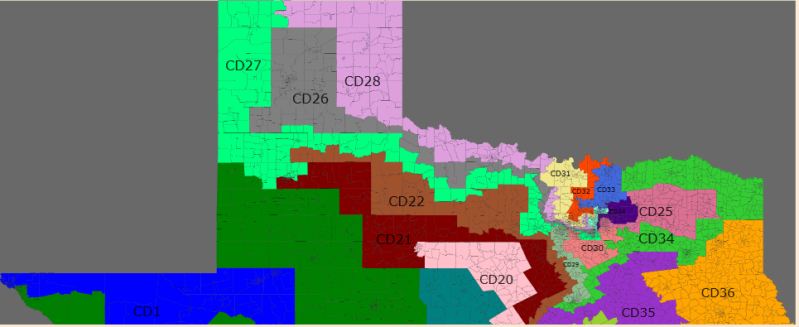
The hardest thing for me to remember when making GOP friendly gerrymanders is that a 50% John MctCain district isn't a toss-up but a likely R district, similar in theory to a 60% Obama District. 5 points more friendly to the gop then the nation as an average implies that, but it is somewhat tricky for me, at least, to wrap my mind around it. However, that was my goal when I started North Carolina: create as many districts that went GOP in 08 as possible. After getting an 11-2 in a state that went for Obama, i figured a 36-0 in Texas was possible. and it was. One district voted for Obama by less than 1000 votes, so I'm going to count it. A 59% Obama district would be okay for most of us here... Without further ado, MAPS!
As always, ask me and i will provide a zoomed in map of whatever area you wish if it isn't clear from the big one.

http://img.photobucket.com/alb...

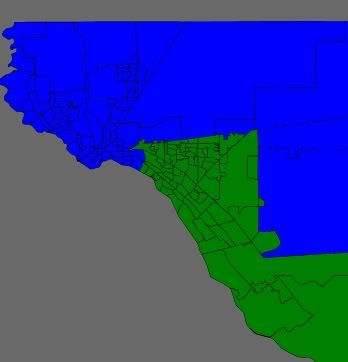
El Paso: http://img.photobucket.com/alb...

District 1 (Blue):  Mccain 56%, 56% Hispanic
El Paso and Odessa

District 2 (Green): M 53%, 63% H
Rest of El Paso and some nearby counties

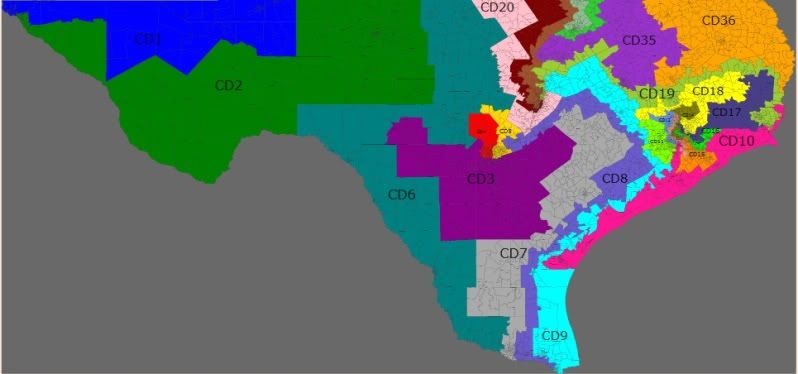
San Antonio and Austin: http://img.photobucket.com/alb...

District 3 (Purple): M 50%, 60% H
South San Antonio

District 4 (Red): M 51%, 50% H
North and West Antonio

District 5 (Yellow):  M 51%, 40% H, 10% Black, 3% Asian
East and North San Antonio

District 6 (Teal): M 50%, 72% H
Laredo and some Border counties, then up to West Texas

District 7 (Gray): M 50%, 66% H
McAllen and Border areas all the way up to Bastrop and Fayette Counties

District 8(Violet) M 51%, 62% H
Brownsville, Mcallen and then up.

District 9(Sky Blue): M 51%, 59%  H
Brownsville, Harlingen, up to Williamson and Milam counties.

District 10 (Pink):  M 50%, 35% H, 16% B, 3% A
Corpus Christi and up
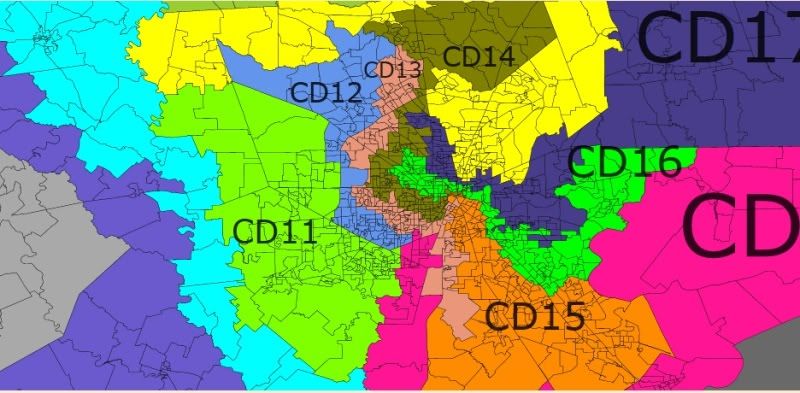
Houston:  http://img.photobucket.com/alb...

District 11 (Lemon-Lime Green): M 55%,  55% White
South of  Houston

District 12 (Blue-Line Green) :  M 56%, 22% H, 20% H, 11% A
Some of the south-west of Houston and then surroundin areas.

District 13(Light Brown): M 53%, W 52%
Houston and some areas north

District 14(Gold):  M 57%,  W 61%
Houston and some areas north

District 15 (Orange): M 52%, 32% H, 19% B, 4% A
South of Houston, with a bit of the city

District 16(Lime Green):  M 52%, 39% H, 12% B, 4% A
Houston and Areas East

District 17(Navy blue): M 52%, 41% H,  16% B
Houston and Areas North East

District 18 (Golden Yellow):  M 56%, 56% W
North of Houston

District 19 (Puke Green): M 56%, 65% W
Wraps around 11-17

District 20 (Light Pink): M 52%, 59% W
Wraps around Austin and takes part of the city then to Abilene

District 21 (Blood Red): M 54%, 66% W
Parts  of Austin then  going to sparsely populated Northern Texas

District 22 (Poo Brown):  M 51%, 79% W
Austin and North Texas

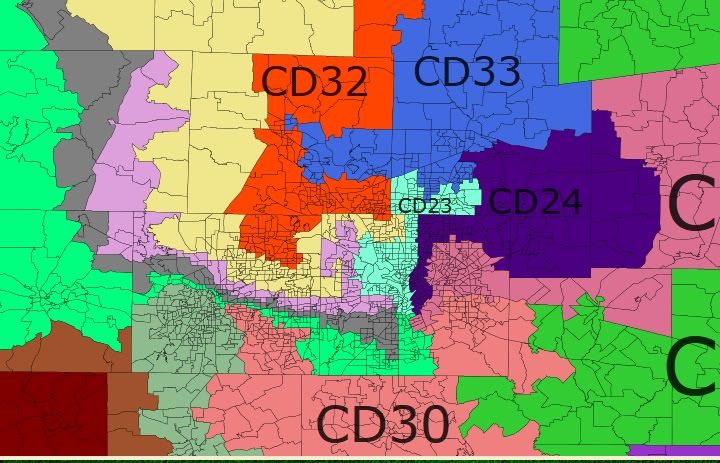
Dallas-FW: http://img.photobucket.com/alb...

District 23 (Robin's Egg Blue): M 54%, 57% W
Dallas and some northern suburbs

District 24 (Dark Purple):  M 56%, 59% W
Dallas and Some Eastern areas

District 25 (Rose): M 54%,  59% W
Dallas then to some less populated eastern areas

District 26 (Silver) M 58%,   54% W
Dallas, FW, then to North Texas

District 27 (Sea Green) M 49%, 54% W
Dallas, FW, then to North Texas

District 28 (Pinkish Purple) M 60%, 57% W
Irving, then up to North Texas

District 29 (Gray Green): M 53%, 60% W
Waco and Forth Worth

District 30 (slightly lighter shade of rose then
the one touching it): M 55%, 60% W
Parts of Arlington, Dallas and Fort Worth

District 31 (Tan): M 61%, 71% W
North Fort Worth and Dallas then North

District 32 (Red Orange): M 64%, 79% W
North FW and then northern areas surrounding it

District 33 (I can't name that many different shades of blue): M 63%, 80% W
North of Dallas

District 34 (Somewhat dark-green): M 69%, 75% W
Wraps around a lot of other districts, filling in a lot of gaps

District 35 (Royal Purple): M 62%, 64% W
Everything Else Part 1

District 36 (Not Flyers Orange, but I'm using it anyways): M 68%, 69% W
Everything Else, Part 2

This is not a perfect 36-0 Map. The last 5-6 districts could bleed some republican voters to some of the more borderline districts. However, in an ok to good year, the republicans win all 36 seats barring an exceptional democratic candidate.

Dave's seems to have deleted my other maps. I'll redo them later and either edit this diary or do a new one, depending on what you guys thing.

Warning_Crazy :: 36-0 Texas
Tags: , , , , , , , , (All Tags)
Print Friendly View Send As Email

36-0 Texas | 37 comments
Good thing for the Voting Rights Act
And that Republicans probably won't be stupid enough to try and baconmander Austin (though it might be a good thing if they try, actually, because we could bank a two or three districts out of that folly).  

22, Democrat, AZ-01
Peace. Love. Gabby.


Hooray for LBJ
Even though the VRA somewhat hampers Dems in places like NJ and NY, it definitely protects us in states like TX, GA, SC, AL, and MS.

Ad hoc, ad loc and quid pro quo!
So little time, so much to know!


[ Parent ]
"baconmander"
I declare that this term shall now be used to describe any redistricting plan that produces roughly-parallel strip districts.

This is most likely the result of cracking, but can sometimes be the result of packing, or simply stringing together geographic bits that ought not have anything to do with each other.

party: Democratic, ideology: moderate, district: CT-01


[ Parent ]
Fajita Strips
We call 'em fajita strips down south. I believe Democratic lawmakers used the term to describe the the districts that ran north-south from central Texas to the Texas-Mexican border.

21, male,TX-08 (home), LA-06 (college, voting)

[ Parent ]
Here is a question...
...since I'm not up to date on the finer points of the VRA.

If we take as a given a high population growth due to either undocuments aliens or non-resident citizens and that they have to be counted due the rules of the census.. is there anything that prevents the creation of majority-minority districts that Democrats can't win since the numbers are inflated with minorities who can't vote?

NY-13, Democrat. Blog @ http://infinitefunction.wordpr...


[ Parent ]
I'm not an expert
But my understanding is that the question is, are there enough minorities in the district who can vote to facilitate their being able to choose the Representative of their choice. In League of United Latin American Citizens vs. Perry, the Delaymander version of TX-23 was struck down because it went from protecting the rights of minority voters to making a district that favored White voters despite a Hispanic majority status because the population over 18 (and thus with the chance to vote) was majority-White. This meant that the district didn't actually represent the interests of the supposedly protected Hispanic population at the voting booth. So you can't just go around creating 50+1% Hispanic districts and pretend that they're automatically going to represent the interests of Hispanic (though the reason the courts appeared to cite doesn't have to do with citizenship, but with the fact that that Hispanics tend to be younger than the population at large).

I don't know how they account for districts like AZ-07, which was only 50.6% Hispanic in 2000 (and where the plurality of people over 18 were White), but enough White voters usually vote in the same interests as Hispanics that the district still tends to support their wishes. I'm also pretty sure though that the Justice Department was apathetic about the creation of AZ-07, or at least that they didn't mandate it, so they probably weren't paying much attention to that or similar districts that look like they just skate by.

Now, what the VRA does not appear to account for right now is districts where there is a large population of non-citizens, resident aliens or otherwise. In places where there are lots of non-citizens and the Whites tend to have different political interests than the Hispanics, like CA-20, CA-47 and TX-23, it doesn't seem like much effort is made to ensure that these districts necessarily represent the wishes of minority voters, and end up having the effect of forcing the candidate who appeals to Hispanic voters to find crossover voters. You could in theory use this to try and squeeze out McCain-voting, majority-Hispanic districts if you have sufficiently conservative Whites (and preferably Hispanics that are more conservative than average).

With all this in mind though, the most effective way to go about your strategy is to have a district that combines conservative Whites with a population that maybe 1/3rd Hispanic, like TX-13. Looks like it's getting close to backfiring on Pete Sessions, but it seems to be working well for Kay Granger. The Justice Department has never mandated a number of majority-Hispanic districts anywhere horribly proportional to the percentage of Hispanics in this country, so there's always going to be a lot of Hispanics left over that can be used (by Dems, or Repubs when you're dealing with Cubans) to pad the margins on majority White or African-American opportunity districts or (by Repubs) to fill in population in conservative districts.

22, Democrat, AZ-01
Peace. Love. Gabby.


[ Parent ]
How to post images
<img src="url"/>

Where url is location of your image (ie. http://img.photobucket.com/alb... )


28, Unenrolled, MA-08


They would attempt something like this, if they could get away with it
It would be huge backfire though, because Democrats could take a good number of these seats in a good year.

24, male, African-American, CA-24, Democrat. Chair of the SSP Black Caucus.

maybe
That map would definitely create a lot of R+3 to R+5 districts that would be competitive (lean R) as of now, and would likely be pure toss-ups later in the decade as Hispanics start to vote more. But I would not expect them to try it, because it would put a lot of hard-right representatives into districts that they could easily lose to a blue dog Dem.

41, Ind, CA-05

[ Parent ]
You have to wonder
if they are going to think of the point you just made. Will they feel as if they can win the districts in a year that is no worse than neutral for the Republicans and thus try to squeeze as many Republican out of the state as possible, or will they toss a few Democrats into the mix while creating some districts that Democrats are unlikely to win even in a good year that adds to their overall total although not as much as is theoretically possible?  

"I have never deliberately given anybody hell. I just tell the truth on the opposition-and they think it's hell."--President Harry Truman. President Obama, are you listening?

[ Parent ]
hmm...
now the real trick is doing a 36-0 Texas map for the Dems :) lol

I don't think that's mathematically possible.
However, now I want to see someone do a 35 D 1 R TX map.  That might be easier if you count a D seat as one Obama won.

Additionally, I might try to do a 4 R 1 D CT map.

party: Democratic, ideology: moderate, district: CT-01


[ Parent ]
33-3 map?
Would be to make three safe D seats, one in Dallas, one in Houston and one in Austin and pack them in the the remaining GOP vote can be used to strengthen some of the weaker distrists.  A 33-3 map could be feasible.

A good idea if you were a redistricting reform supporter
would be to produce a set of maps like this: ridiculous gerrymanders, in each direction, of a bunch of large states.  The point being that if the simple act of drawing the lines can produce a swing between Texas 24D-12R and Texas 0D-36R, then maybe drawing the lines is too powerful an act to continue to ignore.

The only reform I'd support would be a nationwide set of laws governing reapportionment, along the lines of the Voting Rights Act but much more broadly developed, or a constitutional amendment adopting same.  

If it were the constitutional amendment route, I'd love to see a further reform tacked on such that most EVs were distributed to the winner of each congressional district, with only the two statewide EVs going to the winner of the state.  That would radically reduce the "swing state" phenomenon whereby some communities -- Black Belt of the South, Central Valley of CA, upstate NY -- are completely ignored, while other communities in states that happen to be evenly divided are saturated in political attention.  Doing EVs by Congressional District would focus presidential politics on those CDs that happen to be more narrowly divided, but those would fall in a much wider geographic spread than do the "swing states."  However, the districts would have to be reasonably fairly drawn, or else the presidential race would fall victim to the gerrymander, which would be a catastrophe.  Hence the need for a constitutional amendment concerning districting for this change to be beneficial.

Anyway, the point is that these maps help demonstrate just how powerful the power of districting is.  They could be a compelling part of a reformer's argument, ironically enough.

28, gay guy, Democrat, CA-08


Minor flaws in your plan
I completely agree and support an overall reform to the Electoral College; however, your suggestion regarding having it grounded in congressional districts would make the problem worse than it already is. Instead, this would essentially shift the campaign to solely swing districts.

Essentially, under this plan, major campaigning would be done, for the most part, ONLY in swing districts. Additionally, most swing districts tend to be suburban and would be given undue influence over the Presidency.

Rather, a system like the one being proposed, whereby states would allocate all EVs to the winner of the popular vote, would be ideal. Only in this system would the vote of the black voter in New Orleans be equal to his white counterpart in Amarillo and every other American citizen.

21, male,TX-08 (home), LA-06 (college, voting)


[ Parent ]
You may have a point.
As it stands, to win a state like Ohio, you have to appeal to multiple constituencies that manage to roughly reflect the nation as a whole.  If you're a Democrat, you have to win with black people in Cleveland, white college kids in Columbus, union workers in Toledo, some populist rurals in the Ohio River Valley, suburban moms in outer Cleveland, etc.  As an R, it's the same thing -- you have to carry upscale suburbs in Cincinnati, hardcore evangelicals in rural West Ohio, Reagan Democrats in East Ohio, etc.

Meanwhile, under my plan, many of those constituencies would be immediately consigned to one base or another, and the contest would move specifically to the most narrowly divided individual communities.  Those communities would have a much better geographic distribution, but they might have a more similar demographic profile.  I don't think they'd all be suburbs -- places like OH-06, IN-08, WI-08, CO-03, MN-01 have swung back and forth pretty regularly, and they're all mostly small towns.  But you might see more "Reagan Democrat" type elections, wherein one demographic group makes a move and takes sixty districts along with it.  And the strategy of pumping up your base voters, used by Bush in Ohio 2004 and by Obama in Virginia 2008, would not really be available, because your base would be confined to its own districts and would be unable to influence the outcome of entire states.  

I came to this theory when I was in college in Austin in George W's first term.  The votes of Austin liberals literally weren't worth a damn, and the only candidate who ever showed up in town was Nader.  It really seemed unfair that hardhats in Ohio got all of Al Gore's attention while wind-power liberals in Austin got the hair from a possum's tail.  But upon reflection, it's not clear that district-based elections would help.  All that would do is marginalize every college town (Madison, Boulder, Ann Arbor, Chapel Hill) and draw the fight entirely out of the cities.

Furthermore, the fact that Democratic voters tend to be more tightly packed would make a district-based scheme rough on our side.  The most Republican districts tend to be 75-25 at worst. The most Democratic districts are routinely 91-9.  In a district-based scheme, Democratic votes would probably be disproportionately wasted, even if new rules for drawing districts replaced the VRA rules.

It still would be satisfying to know that your vote was "counting."  The Central Valley of CA would know that their votes were helping elect an R, finally, and Austin would know that their 1 EV was helping elect a D.  Knowing that your community was not being erased by your neighbors would be very nice.  But if it drives the presidential contest entirely to the demographic swing groups, and makes not just some base areas (Austin) but ALL base areas (Philadelphia, Ann Arbor) irrelevant, it really would be making things worse, not better.

Huh.  I didn't expect to be so obviously wrong on this one.

28, gay guy, Democrat, CA-08


[ Parent ]
I think it's problematic
When you consider a state like Florida where Obama won the popular vote but lost the majority of congressional districts. He did this by racking up 87% of the vote in FL-17 (and winning most of the districts he won by yawning margins) but only losing with 49% of the vote in FL-25 (and only narrowly losing most of the districts McCain won). Under your plan, yes, the majority of voters in both FL-17 and FL-25 would see their votes count towards the candidate, but the McCain supporters would have much greater influence relative to Obama supporters. There aren't any disparities nearly this large in the current electoral college.

All this system would really do is render most urban and rural voters irrelevant to the political process because candidates would know that even if like 8 people showed up in a safe district, 7 of them would vote for their candidate. Under the current system, those places have clout because they form an ideological base, and a candidate has to make sure that they turn out.

22, Democrat, AZ-01
Peace. Love. Gabby.


[ Parent ]
Great analysis
Yes, thanks for more strongly wording my concerns. This is why I'd be so fearful about a district-based plan. The ONLY fair way to decide the presidency would be by a national popular vote, although I could see an alternativ whereby some basis would be given for the number of states won.

For instance, a formula that would multiply the percentage of the national popular vote a candidate received by the number of congressional districts (435) and then add in 2 votes per state won. Mind you, this is a rough estimate.

This is by no means ideal and probably would require a constitutional amendment, which makes the chances next to nothing. The best way for reform to happen is if states making up a majority of the Electoral College votes get together and pass the popular vote system.

21, male,TX-08 (home), LA-06 (college, voting)


[ Parent ]
It's probably better to simply eliminate the Electoral College
altogether. Your idea is nice in theory, but as others have said, it'd make the contest even narrower in focus.

I've actually thought for a long time that the one thing that could be done to jump start political participation in this country would be to abolish the Electoral College. It would shift the focus to every state, even the really small ones, because once the big ones were tapped out, they'd have nowhere else to go, and this could happen even sooner than I sometimes imagine, if the parties decided when this first happened to start registering voters well in advance of the election. I even think it'd be slightly economically stimulative, because groups all over the country would be trying to leave no stone unturned. There are obviously more potential votes in a state like California, Texas, or New York than there are in Arkansas, Idaho, or West Virginia, but since they all count equally, why not try to get them all, they'd think. They'd hire lots of people to roam the country, and while this money wouldn't be anything special, it'd be a nice way to get some quick cash into the pockets of people who might need it on a temporary basis.

Not that I anticipate this happening for a while, if ever, but it's nice to dream?  

"I have never deliberately given anybody hell. I just tell the truth on the opposition-and they think it's hell."--President Harry Truman. President Obama, are you listening?


[ Parent ]
Yeah
I don't think this would be the best plan for the gop. I would go 32-4, with Austin, Dallas, Houston and South Texas. I just wanted to do it for the sake of doing it.

As for images: I have text to image and i forget that people don't have it sometimes. My apologies, although I think everyone should get text to image asap!

18, Dem, PA-7


Half of the Districts
I don't think this would be the best plan for the gop.

Debbie "I hear scary noises" Riddle is about to really upset Hispanics, who could punish the Texas GOP for decades.  With that and other demographic trends, like increases in Asian American populations, I suspect around half of the delegation of this map might be blue by 2020.


[ Parent ]
The VRA is the only thing in the way of this
Or more likely, the only thing in the way of something like 32-4. It's very likely that every Democratic seat in Texas after the next drawing will be majority-minority, and of those, only the Austin seat will be plurality-white.

20, CD MA-03/NH-01/MA-08

Epic map
great cracking of the cities there.

I'm kinda curious to see a 53-0 map of California now.  Ya know, just for shits and giggles.


Abgin had promised us one of those a few weeks back
I don't think s/he ever posted it, though.

30, male, MI-11 (previously VA-08). Evangelical, postconservative, green.

[ Parent ]
true it is in the way

But I find to make a map as good as it is possible. Then it requires some time, because I need to see and to think before draw. I can not re do 15 districts or more for every little mistake.

I have more than a half of the state so decided.

You will see a 53-0 sure. I can not tell still the minimum percentage of the Obama votes for every district, but I have it so clear.

Sometimes I talk about easier things but I forget not this.


[ Parent ]
yess!
i needed something to help me put off writing my essay for English.

I'll be back.

18, Dem, PA-7


[ Parent ]
oh god
they have the ugliest precincts i've ever seen

18, Dem, PA-7

[ Parent ]
mmm

some of them are really rare :)

[ Parent ]
Redistricting App
Quick question for someone just starting to fiddle with these maps. Once a map is created and districts drawn, how does one view the Obama-McCain margins?

Currently, the appear at 0%-0% in all the districts I've drawn in each map I've attempted (AZ, AR and LA); however, I can see the racial make up of each, which, sadly, in the case of a state like LA, is essentially the presidential margin...

21, male,TX-08 (home), LA-06 (college, voting)


Only available in some states
az,ar, and la aren't some of them

18, Dem, PA-7

[ Parent ]
Yeah, only a handful
IIRC, the states with partisan data are NY, TX, CA, NM, NC, PA, and MD.  

20, CD MA-03/NH-01/MA-08

[ Parent ]
Thank you!
This is all very helpful, thank you!

21, male,TX-08 (home), LA-06 (college, voting)

[ Parent ]
the VRA
is saving the GOP if they thought they could get away with this because it would be a disaster.  

Libertarian secular Republican, MO-7

Not in Texas.
If there was no VRA, they could draw a 32-4 state with those 32 being pretty good Republican seats, as stated upthread.

Ad hoc, ad loc and quid pro quo!
So little time, so much to know!


[ Parent ]
The bid is interesting

And I hope this can help to the people for understand what they will not leave to the democrats in Texas more than the VRA tell. I'm sure the republicans from Texas think they are conceding enough to the democrats respecting the VRA rules.

The most important question after is map is the next

Currently TX-16 (El Paso) is D+10 with 80.9% hispanic population.

The TX-01 of this map is aproximately R+9 with 56% hispanic population.

The VRA would accept the current TX-16 becomes in a district like the TX-01 of this map?

This is the most important question for the redistricting process in Texas.

If the VRA accept this, TX-16, TX-29, TX-20, TX-15, TX-28 (plus TX-27 and TX-23) can become R+5+ districts. That can leave only TX-09, TX-18 and TX-30 as D+ districts in Texas.

But still bid this, this time is very dangerous for the republicans, because they can create new VRA districts easily what can run, while they fail in the court making more republican these districts like TX-16. Then, I keep my preview about the redistricting for Texas.


36-0 Texas | 37 comments

Copyright 2003-2010 Swing State Project LLC

Primary Sponsor

You're not running for second place. Is your website? See why Campaign Engine is ranked #1 in software and support among Progressive-only Internet firms. http://www.mediamezcla.com/

Menu

Make a New Account

Username:

Password:


Forget your username or password?


About the Site

SSP Resources

Blogroll

Powered by: SoapBlox