Google Ads


Site Stats

3 VRA districts in AL, LA, and MD

by: possumtracker1991

Tue Jun 15, 2010 at 10:45 PM EDT


I wanted to take a look at what redistricting might look like in three Southern states (Alabama, Louisiana, and Maryland) with large black populations if, within each state, three VRA districts were created. Right now, Alabama has one VRA district, Louisiana has one, and Maryland has two; this diary has maps that raise that number to three in each state. I also wanted to take a look at what the political implications of this would be on a state-by-state basis; would Democrats be hurt or helped by such plans? Please read on to find out more and leave your comments and feedback as well. Thanks!

Alabama

Statewide Map
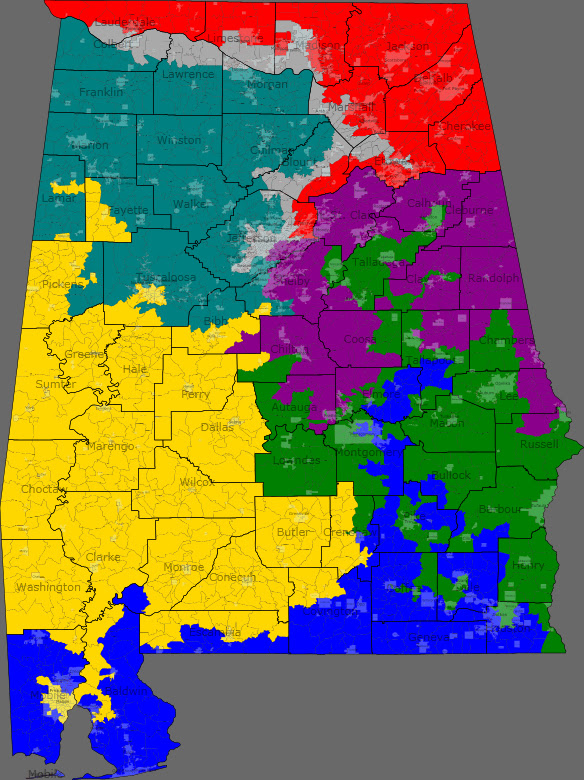
District 1 (Blue): South Alabama-Mobile, Dothan, Montgomery
Demographics: 83% white, 11% black
This is a strongly Republican district that picks up the white parts of South Alabama and then snakes up north past Montgomery. Incumbent 1st district GOP Rep. Jo Bonner would easily win in this district.

District 2 (Green): South/East Alabama-Dothan, Montgomery, Troy, Auburn
Demographics: 48% black, 48% white (black plurality)
This district picks up black areas in South Alabama and Montgomery, and then goes northward all the way to Anniston. This district should be Democratic due to a slight black plurality. While current 2nd district Democratic Rep. Bobby Bright would probably love to have a district like this, he might be vulnerable to a black challenger in a Democratic primary.

District 3 (Purple): East Alabama and Birmingham suburbs/exurbs-Birmingham
Demographics: 85% white, 10% black
This is a very Republican district that essentially combines the eastern half of the current 6th district (Birmingham suburbs and exurbs) with the mostly-white and rural northern areas of the current 3rd district. The homes of two incumbent GOP congressmen, 6th district Rep. Spencer Bacchus (from Vestavia Hills in Jefferson County) and 3rd district Rep. Mike Rogers (from Saks in Calhoun County) are both in this district so they would likely face off in a primary that I think Bacchus would be favored to win.

District 4 (Red): North Alabama-Florence, Madison, Huntsville, Albertville, Gadsden
Demographics: 87% white, 6% black
This is an extremely Republican district in North Alabama that has some of Obama's worst areas and would be easily won by the probable congressman for the current 5th district after the 2010 elections, Republican Mo Brooks of Huntsville.

District 5 (Yellow): Southwest Alabama-Mobile, Selma, Greenville, Tuscaloosa
Demographics: 51% black, 46% white
This district takes in many of the non-Birmingham areas of the current 7th district in what is known as the Black Belt, and it now reaches down all the way into Mobile. This district has a black majority and would be an open seat almost certainly won by a black Democrat.

District 6 (Teal): Northwest Alabama, Birmingham suburbs/exurbs-Birmingham, Tuscaloosa, Cullman
Demographics: 88% white, 6% black
This would be a safe GOP district that merges the western halves of the current 4th and 6th districts and would likely be won by Republican Congressman Robert Aderholt, who lives in Winston County.

District 7 (Gray): Urban Birmingham and North Alabama-Birmingham, Gadsden, Huntsville, Florence
Demographics: 53% black, 41% white
This black-majority district brings the number of VRA districts in Alabama to three by picking up urban Birmingham and then snaking through North Alabama into Gadsden, Huntsville, and Florence. It will be represented by a black Democrat, probably either Teri Sewell or Shelia Smoot.

So overall, Democrats will likely gain from this map. While it essentially closes the door on ever winning any of the 4 white majority districts (all of which are now at least 85% white), it creates 3 districts that should easily fall into Democratic control, unlike the current map, which really only has one safe district for Democrats (the 7th district). So we would see a likely change from either 5R-2D (Bright wins in 2010) or 6R-1D (Bright loses in 2010) to 4R-3D.

Louisiana

Statewide Map
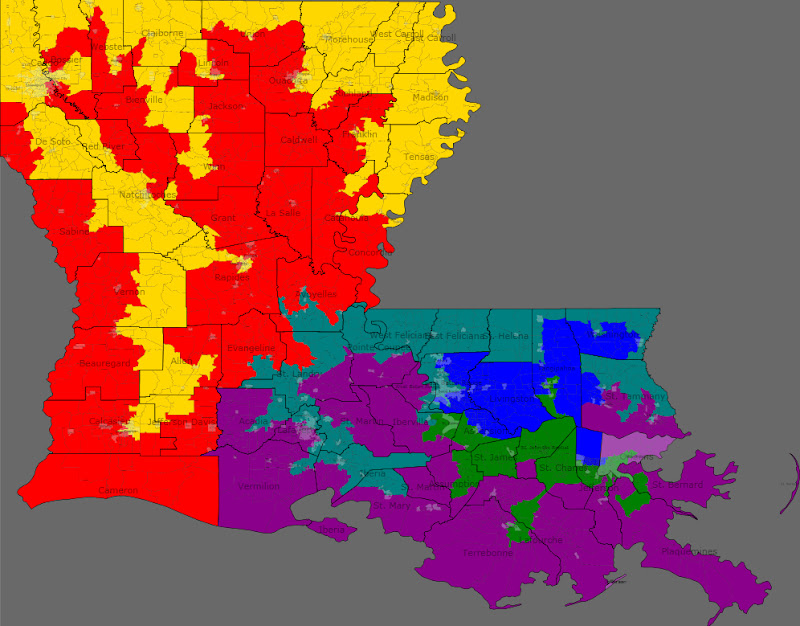
District 1 (Blue): East Louisiana-Baton Rouge, Hammond, Kenner, New Orleans
Demographics: 80% white, 11% black, 6% Hispanic
This is a very conservative and Republican district that picks up white areas between New Orleans and Baton Rouge. Incumbent GOP Reps. Bill Cassidy and Steve Scalise would face off in this district's Republican primary, and it is about half and half of each of their old districts so neither would really have the advantage of incumbency.

District 2 (Green): South Louisiana and New Orleans-New Orleans, Hammond, Houma
Demographics: 52% black, 39% white
This is essentially a successor to the current black-majority 2nd district, although it must expand south and west to make up for severe population loss from Hurricane Katrina. It retains a black majority, and will easily elect a black Democrat, probably either Cedric Richmond or Juan LaFonta, to Congress.

District 3 (Purple): South Louisiana-New Orleans, Houma, Lafayette
Demographics: 80% white, 12% black
This district has many of the white Cajun areas in the current 3rd district, but now extends to the west to pick up much of Lafayette. This district would likely elect a Republican simply due to its overwhelming whiteness, although there would be a fight in the Republican primary between Hugh Downer of Houma, who will likely be the GOP Rep. for the 3rd district following the 2010 elections, and 7th district Rep. Charles Boustany, whose Lafayette base is now in the 3rd district.

District 4 (Red): West and North Louisiana-Lake Charles, Alexandria, Shreveport, Monroe
Demographics: 82% white, 12% black
This district is intertwined with the new black-majority 5th district, taking up white areas in Western and Northern Louisiana and ending up with only 3 whole parishes, the rest of the parishes in the district being shared with neighboring districts. GOP congressmen Rodney Alexander of Alexandria and John Fleming of Minden (in Webster Parish near Shreveport) would have to battle it out in a Republican primary that Alexander would be favored to win, although either would easily hold the seat in a general election in this heavily white and Protestant district.

District 5 (Yellow): West and North Louisiana-Lake Charles, Alexandria, Nachitoches, Shreveport, Monroe
Demographics: 51% black, 45% white
This new black-majority district snakes around the Mississippi and Arkansas borders and then stretches down all the way to Lake Charles, picking up many black precincts along the way. Perhaps former Congressman Cleo Fields would give it a try in this district, although any black Democrat would be favored to win.

District 6 (Teal): East and South Louisiana-New Iberia, Lafayette, Baton Rouge, Slidell
Demographics: 52% black, 44% white
This is the third black-majority district in the state, taking the black areas of Baton Rouge and Lafayette and the snaking along the border with Mississippi and then all the way down to St. Tammany Parish. It would probably be won by a black Democrat from Baton Rouge or Lafayette.

So Louisiana is another state where Democrats would benefit from having 3 black-majority districts. The balance of power would shift from 6R-1D to 3D-3R, a three seat loss for the Republicans and a two seat gain for the Democrats.

Maryland

Statewide Map
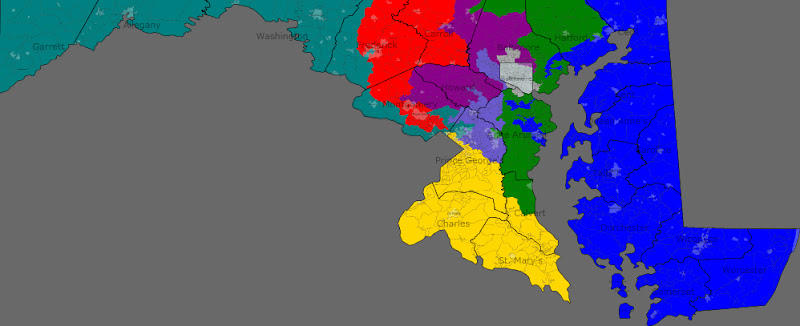
Baltimore Area Map
D.C. Area Map
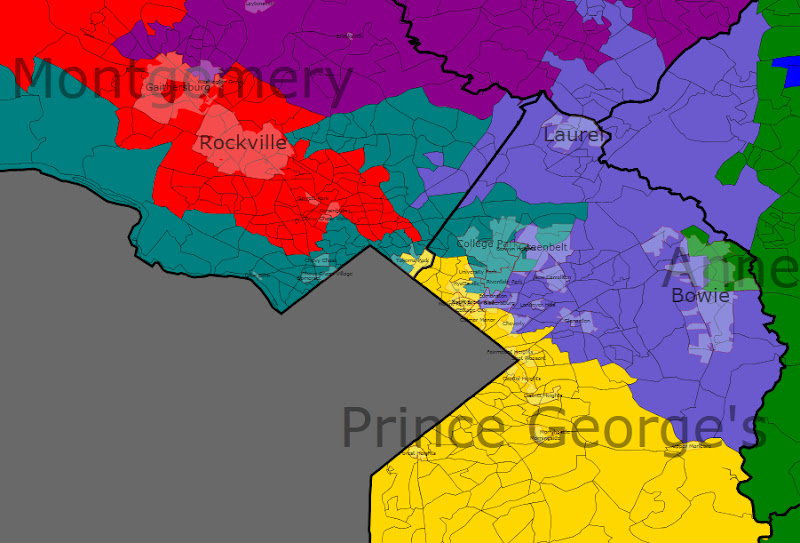
District 1 (Blue): Eastern Shore and Baltimore, Harford, and Anne Arundel Counties-Annapolis, Aberdeen, Eaton, Salisbury
Demographics: 74% white, 19% black
2008 pres. results: 50% McCain-48% Obama
By trading heavily Republican suburban areas in Baltimore and Harford Counties with the 2nd district for Democratic areas in Baltimore and Anne Arundel Counties, this district becomes much more Democratic. While John McCain still narrowly won this district, Frank Kratovil would have no trouble winning this district as it is now mostly limited to Democratic areas and his base on the Eastern Shore.

District 2 (Green): Anne Arundel, Calvert, Harford, and Baltimore Counties-Annapolis, Bowie, Dundalk, Bel Air
Demographics: 86% white, 7% black
2008 pres. results: 59% McCain-39% Obama
This is now a heavily Republican district around Annapolis and Baltimore, a result of the creation of a third black-majority district. It was simply not possible to maintain a Democratic 2nd district and still have the three black-majority districts without threatening Democratic control of the 3rd district. As a result, this district was disproportionately packed with Republicans and gave John McCain a 20% margin of victory. We might finally say hello to Congressman Andy Harris, although he would likely be the only GOP member of Congress from Maryland.

District 3 (Purple): Baltimore, Howard, Montgomery, and Carroll Counties-Gaithersburg, Columbia, Westminster, Towson, Baltimore
Demographics: 69% white, 15% black, 8% Asian, 5% Hispanic
2008 pres. results: 56% Obama-42% McCain
This is a new district that stretches from Montgomery County all the way up to the Pennsylvania border. Both John Sarbanes and Dutch Ruppersberger would likely run in the Democratic primary in this district in order to stay in Congress, although they might split the Baltimore vote, allowing someone from Montgomery or Howard Counties to slip through. A Democrat should win here nonetheless.

District 4 (Red): Frederick, Carroll, and Montgomery Counties-Frederick, Westminster, Rockville, Gaithersburg
Demographics: 66% white, 12% Hispanic, 10% Asian, 10% black
2008 pres. results: 58% Obama-40% McCain
This map is not all bad news for Democrats, as GOP Rep. Roscoe Bartlett sees his Republican district split in half and replaced with two districts where Obama received 59% of the vote. The new 4th district combines most of the current 8th district's portion of very Democratic Montgomery County with parts of Frederick and Carroll Counties. It has 8th district Rep. Chris Van Hollen's home in Kensington and Van Hollen could easily defeat the very conservative Bartlett (who would also be 86 years old by Election Day 2012) in this Democratic district.

District 5 (Yellow): Montgomery, Prince George's, Charles, Calvert, and St. Mary's Counties-La Plata, Waldorf, Clinton
Demographics: 55% black, 33% white, 7% Hispanic
2008 pres. results: 78% Obama-21% McCain
The first of Maryland's black majority districts, half of this super-Democratic district is made up of areas from Democratic Rep. Donna Edwards' current 4th district and Chris Van Hollen's 8th district, while the other half of the district comes from Democratic Rep. Steny Hoyer's current 5th district. This new district is 56% black and contains Edwards' base in Prince George's County, although it also has Steny Hoyer's base in Southern Maryland and the House Majority Leader would no doubt be difficult to topple in a primary. I think a primary would be very competitive between the two incumbents, so Edwards might decide to instead run in the new black-majority 8th district.

District 6 (Teal): Panhandle and Frederick, Montgomery, and Prince George's Counties-Cumberland, Hagerstown, Frederick, College Park
Demographics: 65% white, 14% black, 12% Hispanic, 6% Asian
2008 pres. results: 59% Obama-39% McCain
This district is the second nail in the coffin for Roscoe Bartlett. The conservative rednecks living in the Panhandle are placed in the same district as liberal voters in Prince George's and Montgomery Counties, and the University of Maryland's campus in College Park is placed in the district as well. While Van Hollen's home is in the 4th district, he could easily run here and win, even against Roscoe Bartlett. Former 8th liberal Republican Rep. Connie Morrella would have likely defeated Van Hollen here in 2002 though. I really don't know which of these two districts Van Hollen and Bartlett would run in, but I think they would both elect Democrats.

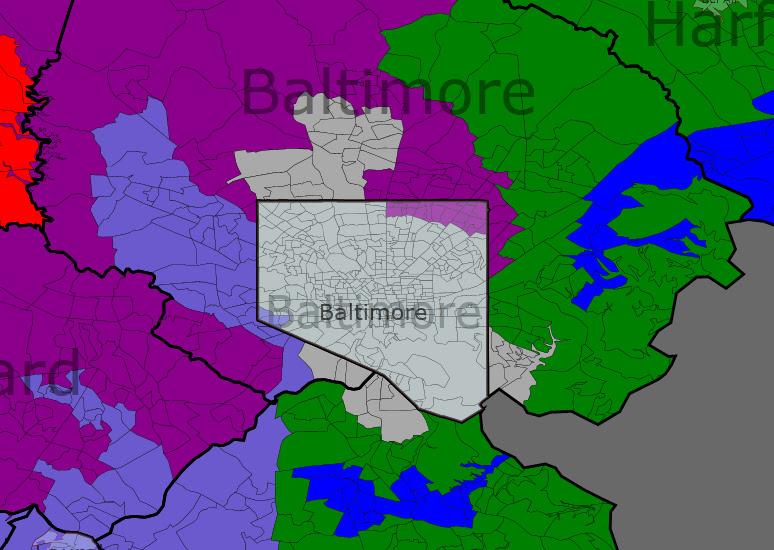
District 7 (Gray): Baltimore City and Baltimore and Anne Arundel Counties-Baltimore
Demographics: 55% black, 38% white
2008 pres. results: 80% Obama-18%  McCain
This black-majority district takes up nearly all of Baltimore City and some surrounding areas. It is very Democratic and would retain Democratic Rep. Elijah Cummings as its representative.

District 8 (Lavender): Baltimore City and Baltimore, Howard, Anne Arundel, Prince George's, and Montgomery Counties-Baltimore, Columbia, Laurel, Bowie, Greenbelt
Demographics: 55% black, 29% white, 8% Hispanic, 6% Asian
2008 pres. results: 84% Obama-15% McCain
This is the third black-majority district in the state as well as Obama's best district, picking up black areas in between Prince George's County and Baltimore. While Democratic Rep. Donna Edwards might choose to run here rather than face Steny Hoyer in a primary, it would likely be an open seat won by a black Democrat.

So it is definitely possible to make three black-majority districts in Maryland. However, would this plan necessarily result in three black representatives being elected? Districts 7 and 8 would easily elect black congressmen, although Steny Hoyer might continue to win in the 5th district despite its new black-majority due to significant establishment support. The three black-majority districts are not an obstacle to toppling Roscoe Bartlett, although they must sacrifice either John Sarbanes or Dutch Ruppersberger. The change after redistricting would be minimal, going from a 7D-1R (Kratovil wins in 2010) or 6D-2R (Kratovil loses in 2010) split to a probable 7D-1R split (assuming Kratovil wins the 1st district seat). Despite the lack of a change in partisan balance under this map, Democrats would probably want to avoid forcing Hoyer into a tough primary and losing Sarbanes or Ruppersberger, so this is one state where three black-majority districts would be a bad thing for Democrats.

Thanks for reading and please leave your comments and feedback!

possumtracker1991 :: 3 VRA districts in AL, LA, and MD
Tags: , , , , , , (All Tags)
Print Friendly View Send As Email

Those are works of art!
However, I think you may have diluted black voting strength in the existing districts too much, from a legal standpoint.

Follow the elections in Georgia at the 2010 Georgia Race Tracker.

While they are beautiful gerrymanders
They'd be almost certain to be struck down, on the grounds that:

1.  You can't use race as the predominant factor in creating a district.
2.  You can't dilute minority voting strength in an existing VRA district.
3.  You generally need a bit of a "cushion" in a district, to account for differential turnout.  Because African-Americans are less reliable voters, a 51% A-A district will often end up electing a white guy.

I'm not sure what the rationale behind some of these grounds is; sometimes I think the courts make up VRA interpretations as they go along, particularly with all the Republican-appointed federal judges (it's no coincidence that most interpretations of the Voting Rights Act wind up hurting Democrats, particularly in the Deep South.)

And I agree with you that creating an extra black-majority district in Maryland is pretty much pointless.  Maryland isn't a state like Alabama or Louisiana, where we have a tough time winning in non-VRA districts.  Plus Maryland would scarcely like to lose the House Majority Leader.

26, white male, TX-24, liberal-leaning independent


In Maryland
a black would likely win a 40% black district easily.  In Alabama, that might not be the case.

[ Parent ]
That might have been true 20 or even 10 years ago
But since then, many white voters in the Deep South have continued to switch parties and become Republicans. As a result, a district in Alabama or Louisiana that is 50% black would have a Democratic primary electorate that would likely be at least 2/3 black and would choose a black candidate in the primary in most situations. In November, there would be enough black voters and white Democrats to easily push the black candidate to victory.

In my home state of North Carolina (where there are still many white Democrats to win over the primary), most VRA state legislative districts are only about 50% or so black and are almost all represented by black legislators.

In addition, all of the districts in my diary are at least 51% black (with the exception of AL-02, which is 48% black).


[ Parent ]
in New Orleans
a 40% black district should be enough. Then you can have a compact district around New Orleans instead of one with tentacles into black rural areas.

26, male, Dem, NJ-12

[ Parent ]
I don't like the AL and LA maps because
They hurt our chances at getting white Democrats elected who could later run for higher office (Senator/Governor) because I do not realistically think a black candidate could win statewide in either state very easily. We can't forget also that a Democrat won AL 05 in 2008 and we came damn close to holding onto LA 06 and picking up LA 04. I think it would be a shame to eliminate the ability for these candidates to win and close the door on winning the Congressional delegations in these states (we have majorities in MS and AR).  

I don't agree.
I'd much rather have a map that is virtually guaranteed to elect a few Democrats who stand a good chance of being good Democrats than a map that will result in, at best, more Bobby Brights and Jim Marshalls so, down the road, there can be more Mary Landrieus and Zell Millers.

Follow the elections in Georgia at the 2010 Georgia Race Tracker.

[ Parent ]
Remember Artur Davis
In smaller southern states, I suspect that African American Ds are tempted to tack right to preserve their chances to run statewide.

What's that district in SC where the African American R has a decent chance of election?


[ Parent ]
That doesn't seem true of Bennie Thompson or Jim Clyburne


Follow the elections in Georgia at the 2010 Georgia Race Tracker.

[ Parent ]
who are in good standing
in the House leadership. I am glad for their continued re-election, and safe districts for them.

Yup, I'm of two minds on this issue.


[ Parent ]
Hrmm
Since when has Thompson or Clyburn ever even been rumored to run statewide?

It was widely known that Davis wanted to run for statewide office.

Look in Georgia, Thurmond, Baker, Bishop and Camon are all Conservative Democrats and all are either running statewide, have ran statewide, or, in Bishop's case, rumored frequently to run statewide. You never hear about Lewis, Johnson, or even Scott.

I think it is fair to say that a black candidate who wants to seek higher office is more likely to build a coalition as a Conservative Democrat, because, frankly, that's the only way to win in these Southern states.


[ Parent ]
If I were a black candidate in the Deep South
who wants to run statewide, I would not run for Congress from a black majority seat.  Because you lose both ways, support the national party and come off as an unelectable liberal, or oppose the national party and lose black votes in the primary like Davis did.  Even an excellent candidate like Harold Ford had trouble.

A successful black candidate in the Deep South is better off in local or state office where you are not forced to build a record to alienate some constituency.

Thurbert Baker and Michael Thurmond would probably be much better suited as a candidate for Governor or the Senate than would Bishop or Scott.  (I agree that John Lewis and Hank Johnson are simply non starters.  David Scott may be able to win a statewide race in a good year, but his voting record in Congress may doom him.)


[ Parent ]
Well
Actually, Bishop has been rumored many times about being a candidate for state office. Whether or not he's actually shown any interest is something I know nothing about.

He built a strong coalition of whites and blacks to win his seat the first few times. He's still got a good coalition today that Scott, Johnson, and Lewis, would have trouble crafting.

Scott, Johnson, and Lewis, however, have no chance statewide. Lewis is too polarizing while Scott and Johnson just would not be able to build the center-right profile needed to run.

Baker's been a staunch advocate for law enforcement and is known as a social conservative which is obviously a necessity in Georgia.

Thurmond's a longtime DLC supporter, and he's fairly moderate on social issues.


[ Parent ]
Bishop
The thing is that Artur Davis also did what Bishop did, a centrist record that was intended for a statewide run.  But he lost half the black vote in the primary to Sparks, who ran to the left of him.  

I suspect that the Atlanta black organization may do the same thing to Bishop(who did vote for HCR, but likely would have voted no if he was running statewide this year.) as the Alabama ones did to Davis if there was an Atlanta-based white candidate to the left of Bishop.  And if Bishop is nominated, even his centrist record would be under attack by the GOP, see what happened to Harold Ford.    

I think Baker and Thurmond would probably have an easier time in avoiding that fate than would Bishop, because they don't have a voting record in Congress, even though they would all have roughly the same record in the Senate.  

My feeling is that the only Democratic Congresspeople in the Deep South who could win Senate or Governor races are Bobby Bright, Gene Taylor, Jim Marshall, and maybe John Barrow. And it would be uphill with any of them in the current environment.  Melancon might be able to win in a different year.

Lesson is that we should nominate statewide officeholders and not Congresspeople.  They are much harder to tie to the national party.


[ Parent ]
No Way
The only part I agree with you on would be the GOP attacking Bishop's record. Other than that I totally disagree.

Davis recently discovered his centrist ideology. Bishop's been a longtime leader of the Blue Dogs.

Bishop's been a conservative leaning Democrat since he was first elected, almost two decades ago.

Due to the redistricting mess here, Bishop's also represented quite a large portion of Middle and South GA at one time or another. He's represented a wide area of voters, while Davis represented the same constituency for his entire Congressional career.

Bishop's got a fine relationship with the black establishment, Davis has always been considered more of an outsider.

I'm sure Baker and Thurmond's service in the state legislature would be scrutinized by the GOP to no end, as would Bishop's.

Other than the Bishop comments, you make some great points. I agree about Bright, Taylor and Marshall.


[ Parent ]
So what you are saying is
that Bishop has close ties to the black leadership who know he is a centrist, so there is mutual respect, but the black leadership thinks that Davis was an opportunist and self-serving and they never liked him anyway.

Baker's and Thurmond's records were 20 years ago, so it is easier to distance themselves from their records back then.

Still if an open seat comes up in Georgia, Marshall is probably the best candidate, followed by Baker.  Do you think Marshall would have beat Saxby Chambliss in 2008?  


[ Parent ]
Well
I'm not sure its entirely accurate to compare the "black establishment" in Georgia to the "black establishment" in Alabama, but I guess so.

Oh, I agree there, Marshall is the best candidate we have for a Senate seat. Baker would be great as well, though I'd probably place Jim Butler in the 2nd slot. Baker would be in my top 5 though.

I do think Marshall would have beat Saxby in 2008. I like Martin personally, he's a stand up guy and one of the few sincere politicians out there. However, his views were far too liberal for the state. He came close but a Conservative Democrat would have easily won.


[ Parent ]
It's SC-1, However I'd Say Slightly Better than 50-50
Tim Scott has the Club for Growth and some GOP Congressmen behind him for the runoff.  However, Paul Thurmond (Strom's son) has the endorsements of 5 out of the 6 primary losers who have endorsed.  The third place finisher (son of former SC governor Carroll Campbell) endorsed him along with the top finisher in Horry County (includes Myrtle Beach and is the second largest county in the district).  Plus, Thurmond is more amenable to funding infrastructure in the district.  One thing is for sure.  That is that the Democrat who is running for the seat in November, a perennial Congressional candidate named Ben Frasier, is sure to garner a lot less votes than 2008 Democratic nominee Linda Ketner did.  She had good campaign fundraising that included personal wealth, a damaged incumbent she was facing, and a Democratic favoring political environment.  Frasier has none of those advantages and he has residency issues in addition to disjointed issue positions.  

[ Parent ]
I hate to root for any Thurmond kin
but I hate the Club for Greed.  So yes, I prefer Thurmond.  Too bad we don't have a decent nominee here.

[ Parent ]
Yep
This is a simply copy of the GOP's purity playbook.

Look at where it got them.

A majority coalition that can sometimes get things done is much better than a minority liberal coalition that gets nothing done.

Politics is all about coalition building.

What you advocate is in reality just an endorsement of a GOP majority.


[ Parent ]
The GOP playbook actually worked
They have been the majority party for the last 30 years, with a few windows where the Dems had power, but for the most part, the right-wing GOP approach did work.

[ Parent ]
That was a different GOP playbook
Where they relied on wedge issues, starting with segregation in '64, busing in '72, lower taxes on the working class in '80, and several "dog whistle" issues to boot.

The current GOP playbook relies on none of these.


[ Parent ]
The current GOP
has run into a demographic wall.  They can no longer rely on the same tactics because they can't write off 90% of blacks, two-thirds of Hispanics, two-thirds of young people and still win.  They can't keep running anti-intellectual candidates and not get beaten in the suburbs.

But they can still win running as hard right conservatives, but they'll have to package candidates much better.  See Bob McDonnell in Virginia.  The reason why he did better than Bush or McCain in NoVa is because he came off as a intelligent and competent, not as a buffoon who suggested that his opponents were anti-American (i.e. Bush and Palin).

To win back the suburbs, the GOP will need to nominate someone who respects intelligence and learning.  Someone like Bobby Jindal or Mitt Romney would play much better than Palin or Huckabee.


[ Parent ]
It's a more narrow needle
The question is whether the GOP wants to return to the 'burbs or the white working class. To some extent, what you say is true for the 'burbs.

OTOH, if the GOP wants to go for the white working class vote, Palin and IMO especially Huckabee are more well suited.

If current trends with Hispanics continue, that window of opportunity for the GOP will close within a decade.


[ Parent ]
I don't think the GOP can get that much more
of the white working class vote.  Obama won just 40% of that vote (non college educated whites), and still won by 7%.  There just isn't that much more there to be mined.  And nominating Huckabee or Palin will guarantee that more college educated whites will not vote GOP than in 2008, which would wipe out most of the advantage they may get among white working class.

The GOP has mined almost all they can among white working class voters.  They have to do better among college educated suburbanites or win over the more socially conservative minorities.  And I don't see any Republican doing well among blacks or Latinos in 2012 because of Obama and immigration.


[ Parent ]
Also
The suburban voters went toward the Democrats during the 90's because of the religious right. Now that the religious right has become quieter, the Republicans have a shot at getting the suburbs back.  

for more election analysis, visit  http://frogandturtle.blogspot....


17, CA-06,  


[ Parent ]
The GOP did worse in the suburbs
in 2006 and 2008 than they did in the 1990s (exception being the NYC suburbs).  

The religious right was quieter in 2008, but that didn't help them there.  I think Bush and Sarah Palin's anti-intellectual and Joe McCarthy-like campaign turned off a lot of voters in the suburbs.  

Bob McDonnell is directly from the religious right, but he did well in the Northern Virginia suburbs.


[ Parent ]
Oh Ok
Then why don't you start up a group dedicated to dissolving the Blue Dog Coalition, work hard to purge moderates from the party and institute a strict liberal policy list.

Establish chapters in each state, make it a real grassroots organization.

I'm sure that will be a real winner nationwide.

Oh, and when you say the majority party for the last 30 years, where and on what level?

Not Congress. Not in most of the South.


[ Parent ]
Chill out
I'm not interested in doing that.  If there was a strict liberal policy test, I'd be one of the first ones purged.  

But the GOP's strategy did work, they did craft an ideological majority from scratch, given that they were a weak minority party from 1932-1968.  It is hard to argue that the GOP long-term strategy failed, it just ran into a demographic wall.  


[ Parent ]
Ok
I think tietack's post above mine sums it up well.

I simply said purity strategy, guess I should have specified what I meant. The GOP of the past couple of years is much more extreme than a decade or two ago.

Unless maybe moderates just now decided to start fleeing...


[ Parent ]
The GOP has really only gone off the edge
in the last 2 years, and after they lost their majority.  These teabaggers are actually quite similar to some of the extreme anti-war elements in the late 1960s.  While a lot of the country would agree with many of their complaints (same with the anti-war groups around 1970), the manner in which they push their agenda is quite off-putting to middle America. The only thing we haven't seen yet is a major act of violence (no analogy to the Weathermen).

The question is whether the GOP follows the script of the early 1970s Democrats and nominates their version of George McGovern (Sarah Palin?).  


[ Parent ]
This is not scientific
but look at the tone on RedState.  2 or 3 years ago, the tone was conservative and activist, but you still had a place for intelligent discussion.  Now you simply have angry diary after angry diary there.  It is simply attacks and angry diatribes against Obama and so-called RINOs, and very little about actual policy of any kind.

You see the same thing on dKos to a large extent, but the Democrats listen far less to dKos types than the GOP does to RedState types.


[ Parent ]
Whatever.
The Republicans lost because their CONSERVATIVE IDEAS fucked up the country.  Voters turned on them because of the state of the economy and the screwup that was Iraq.  Of course, there were factors like corruption and Sarah Palin, but NOWHERE was "They're running out the moderates" a top choice. Not to mention, the Republicans who lost included [relative] moderates like Lincoln Chafee, Chris Shays, Mike DeWine, and Jim Leach.  Those that nearly lost include Deborah Pryce (who gave it up the next go around), Mark Kirk, Jim Gerlach, and Dave Reichart.

So how about you stop making up history?

Follow the elections in Georgia at the 2010 Georgia Race Tracker.


[ Parent ]
More Complicted
But isn't one of the real questions how much those moderates where hurt by the percieved rightward shift of the GOP.  A lot of voters know little or nothing about their Rep so but the letter next to their name so records of moderation may not help.

Also, a lot of voters who liked Chaffee for example were turned off by the rightward drift of the GOP and refused to vote for continued GOP control of the Senate even though they liked Chafee and his moderation.

I don't know how you really control for those variables but I am suggesting that a move to purity might actually hurt the moderates first.  It is at least plausible that voters in the most moderate districts might sense that the national party is moving away from their perfered (moderate Rep) and vote to punish the national party notwithstanding the moderation of their rep.

Sorry, that is poorly stated but I'm at work and break is over so no time to clean it up.


[ Parent ]
I don't think I can agree.
More people were fine with voting for a conservative Republican in before 2006/2008 than after.  While the Club For Growthers (using that term generically) were active before now (e.g. taking out Schwarz in 2004 and trying to take out Specter the same year), they've seemed to become more active this cycle than before.  So, I don't think the push for conservative purity has much to do with it on a macro level.

The over-arching theme of the past two elections was more that the Republican brand was in the shitter due to the economy, corruption, Iraq, Katrina, etc, not because of some recent shift in ideology.  In general, most of the moderate ones that lost, did so not necessarily because their constituents were spiting the Republican Party; many were seen as enablers of a failed agenda despite their purported moderation.  

Plus, if you go through the seats we picked up, the vast majority where in states/districts that were already blue at the Presidential level in 2006, would turn blue in 2008, or were only slightly red.  Off the top of my head, seats falling into the first category include PA-Sen, OR-Sen, KY-03, IA-01, IA-02, CT-02, CT-04, CT-05, FL-22, PA-07, PA-08, and CO-07.  In the second category, there is MN-01, IN-02, NY-20, NY-24, NY-19, both VA-Sen (both), OH-Sen, CA-11, NM-Sen, and CO-Sen.  And in the third, there was AZ-01, AZ-08, CO-04, and NC-11.  These were generally seats where Republicans had less room to play with.

Follow the elections in Georgia at the 2010 Georgia Race Tracker.


[ Parent ]
Pretty sure Schwarz lost in 2006
because for Tim Walberg's first election against Sharon Renier, he won narrowly, then lost the next time to Schauer.

21, dude, RI-01 (registered) IL-01 (college)
please help Japan. click "donate funds" in upper right and then "Japan Earthquake and Pacific Tsunami." http://www.redcross.org/


[ Parent ]
Oops. You're right.


Follow the elections in Georgia at the 2010 Georgia Race Tracker.

[ Parent ]
That's just nonsense
I'll leave aside the ideology here, because I don't think it's relevant.

The question is this: are we likely on current trends to win 3 districts in each of Louisiana and Alabama, whatever national climate, without having to spend millions every single year?

The answer is surely no. With Melancon going statewide, we'll likely lose LA-03. Cayazoux couldn't get re-elected and Carmouche was beaten in 2008, and the trends are against us. Except for the fact it's held by a Republican (which I think we can all agree is a fluke), LA-02 is the safest Democratic seat in Louisiana by a mile. Why? Because it's black-majority?

Similarly in Alabama. Not everybody will do as badly as Obama did with white voters there, but it's uphill either way. Neither Brown nor Griffiths won by large mountains and one of those is already gone, with the other endangered. Once again, AL-07 is the only one that doesn't hoover up DCCC dues that could be used in districts that are trending our way and in states where there are also competitive statewide contests.

Whether you want one fairly liberal black Democrat and two conservative white Democrats who are perpetually endangered or three fairly liberal black Democrats is an issue of policy preferences. But picking the three black Democrats is actually the better bet in terms of safeguarding the House - they won't get beaten.

I see what you're trying to say in terms of ideology. I disagree, but I see it. But in pure numerical terms, your prescription is more likely to lead to a GOP majority, as there's no way we'll get Democratic majorities in the LA and AL delegations for the forseeable future.


[ Parent ]
It's nice to see it can be done
I would support 2 VRA districts each in AL and LA. I endorse TheUnknown285's map for AL. In MD there's a good chance Steny Hoyer's successor will be black even if you leave the district the way it is.

When 1/10 of all districts that are 10% black have a black Congressman, that will be the day we no longer need VRA districts.

26, male, Dem, NJ-12


AL is particularly impressive
I wouldn't have thought that was possible.

Thanks!
It was hardest to make the green district (AL-02) since I had to keep trying to find a balance with the neighboring white majority districts. I wasn't sure if it would be possible, but I divided the total black population by three and found that product to be more than half of the total population required in each congressional district.

[ Parent ]
Love LA
Hope it never happens, but it looks nice! One slight nit-pick: Bill, not John Cassidy. Also, can't tell where I'd be, the 1st district or 6th. I can NOT live in  a Dem district!

Thanks!
I appreciate the kind words, especially since you're from Louisiana. I will change the Cassidy thing, I might have been mixing his first name up with John Fleming's. If you tell me what parish you live in, I can post a detail map of that parish and you can see which district you live in.

[ Parent ]

Copyright 2003-2010 Swing State Project LLC

Primary Sponsor

You're not running for second place. Is your website? See why Campaign Engine is ranked #1 in software and support among Progressive-only Internet firms. http://www.mediamezcla.com/

Menu

Make a New Account

Username:

Password:


Forget your username or password?


About the Site

SSP Resources

Blogroll

Powered by: SoapBlox